According to the Centers for Disease Control and Prevention, disease and nonbattle injuries are the leading cause of death for US military personnel in conflict zones. A study published in the journal Respiratory Physiology & Neurobiology indicates that military personnel are also three times as likely to contract respiratory infections as the general population.
In remote areas of conflict, where access to hospitals and labs is limited, diseases like malaria, dengue, and leptospirosis pose a serious threat. These diseases present with a vague set of symptoms that can often be misdiagnosed, delaying timely, vital treatment. In many cases, the military must evacuate soldiers from combat areas for testing and treatment, which can delay missions, exhaust time and resources, and endanger military personnel.
To fill the void of reliable and rapid testing for a range of infectious diseases in remote combat areas, a team of graduate students in the Center for Leadership Education has developed a rapid, multi-pathogen diagnostic, called IRIS, that can run on-site without lab equipment, electricity, or trained technicians.
“IRIS was built around a simple but urgent need to make critical diagnostic decisions possible in places where lab infrastructure does not exist. Instead of using multiple single-disease tests or relying on complex equipment, IRIS brings a multiplex approach into one portable system,” said Laxmi Sahithya Udtha, IRIS lead scientist and student in the MS in Global Innovation and Leadership through Engineering (MSIL) program.
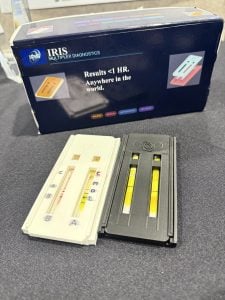
The IRIS prototype
The team’s multiplex diagnostic system detects common pathogens in a single kit, allowing on-site technicians to quickly diagnose a variety of diseases, including malaria, dengue, COVID, leptospirosis, and influenza A & B using blood or a nasal swab within an hour.
The project began in the CLE course Innovation and Design, which challenges students to “systematically decompose problems to understand root causes by researching trends and analyzing within political, economic, social, and technological contexts, in order to determine which problems were solvable, useful, and would foster innovative opportunities and solutions,” said Contessa St. Clair, IRIS communications lead and current MSIL student.
Designing a single cassette capable of testing for multiple pathogens that is also durable and easy for non-experts to use posed a challenge for the team. In rapid, point-of-care tests, lab-created antibodies latch onto antigens from the patient sample, called a “lock and key” reaction, causing a visual change on a test strip. In a multiplex testing system, cross-reactivity increases, potentially affecting the accuracy of the tests.
“Achieving high sensitivity without any lab instrumentation meant every component had to be carefully optimized, especially the selection and validation of antibody-antigen pairs,” Udtha said. “Beyond that, designing and ruggedizing the cassette to handle heat, humidity, and rough handling was just as important as biology itself. The challenge was not just building something that works, but something that works reliably anywhere.”

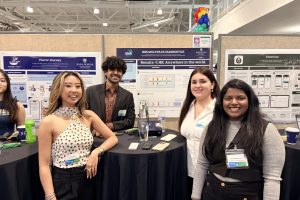
IRIS presenting their prototype during their Round 1 pitch at HopStart 2026
“This team did a particularly good job gaining a deep understanding of the science behind multiple diagnostic techniques,” said Alissa Burkholder Murphy, director of the Multidisciplinary Engineering Design program and a faculty advisor on the project. “They were able to identify the most appropriate diagnostic technology—Multiplex Lateral Flow Assays—through literature and experts and develop a kit to address multiple infections relevant to combat zones. Their strength is in their multidisciplinary team with expertise that spans technology, healthcare, humanities, and the arts.”
After developing the technology to support their idea and building a prototype, the students competed in HopStart: Hopkins New Venture Challenge as a component of the Innovation and Design course. Throughout the two-semester course and in the competition, the team worked to develop a business plan and pitch under the guidance of a network of advisors and mentors, including NATO representatives, researchers at Hopkins, and medical technology SMEs.
The team partnered with jHubMed, a unit of the United Kingdom’s Cyber & Specialist Operations Command (CSOC), that works to deliver medical innovations for the UK military and more broadly in collaboration with NATO. The organization provided feedback on how the system should function in real scenarios and encouraged the team to carefully consider how the test may be used in high-pressure situations.
Beyond guiding the team on the science and design of the diagnostic system, jHubMed also advised the team on their potential to commercialize their product. “[jHubMed] gave us the most direct validation we received,” said Kavin Srirangarayan Rangaraj, a student in the MS in Engineering Management program. “They walked us through the procurement pathways that matter — DIANA, NSPA, and bilateral DoD contracts. That conversation shifted our approach from ‘build a device’ to ‘build a device that fits into an existing procurement structure.’”
With this guidance, they built both an innovative technology and an effective business plan. “Throughout the two-semester course, they had to identify and meet with technical subject matter experts,” said MC Coghlan, senior lecturer in the CLE and one of the team’s advisors. “This kind of interaction across industries pushed their thinking and their ideas. The business acumen went from a general cost analysis to a deep understanding of competition and market potential.”

IRIS celebrating their first-place win at the HopStart 2026 awards ceremony
Their mentors also helped them to understand that leading with the science does not always compel an audience. “Every audience wants to know the stakes,” said IRIS lead product manager and MSIL student Alexa Fermin. Instead of beginning with the product, the team learned to paint a picture: a soldier with fever and joint pain entering a medic tent with limited resources. “This is not a vague user persona. It is a life and death moment where existing solutions aren’t working. When we tell that story, specifically and viscerally, before revealing the solution, we’ve watched the room shift. People lean forward. Tech stops being a product and becomes a solution to something tangible.”
Their work paid off. On Friday, April 24, IRIS won first prize ($5000) in the healthcare category at HopStart, and on Tuesday, April 28 at Design Day, they were awarded a Media Spotlight Award ($1000), recognizing projects that have the potential to reach a broad audience through public-facing visual storytelling. Looking toward the future, the team plans to apply for a provisional patent for IRIS, secure additional funding through multiple channels, and looks forward to further opportunities for mentorship.