An estimated 50% of adult women experience urinary incontinence. The impact of this condition can be significant, including restless sleep and needing frequent access to restrooms. In addition, patients with incontinence must endure wet clothes or sanitary products, irritated skin, and anxiety related to potential accidents.
There are existing surgical solutions that manage incontinence, but these solutions often do not treat the primary cause of incontinence in women. They also tend to result in higher risk factors, lack of adjustment options, or the need for revision surgeries after implantation.
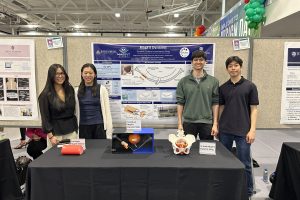
To better meet the needs of women suffering from incontinence, undergraduate engineering students Felipe Aceves, Katie Cariaga, Allyson Chiu, Hailey Lee, Kevin Lu, and Jonathan Peng, seniors in the Center for Leadership Education course Multidisciplinary Engineering Design, have created a novel urethral sling, which supports the tube just below the bladder to prevent urine leakage.
The team partnered with clinicians at the Johns Hopkins Bayview Medical Center, who allowed them to observe procedures. Victoria Handa, MD, director of the Department of Gynecology and Obstetrics, helped the team understand existing treatment methods, and Jamie Wright, MD, director of Urology, provided feedback on the design of their device.
The team’s prototype, including the white surgical mesh and 3D-printed linear adjustment region.
“Seeing current incontinence devices being used in the operating theater firsthand highlighted practical constraints like limited surgical workspace, how instruments are maneuvered, and how precise sling placement and tensioning are achieved,” said Katie Cariaga, a materials science and engineering major. “Dr. Handa helped us directly connect our design choices to real surgical workflows and usability considerations.”
After gaining hands-on experience at Bayview Medical Center, the team landed on their solution: a magnetically adjustable sling that could easily be loosened when the patient urinates and tightened to prevent leakage. This design improves on existing static slings or alternatives like electrically operated slings, slings based on shape memory alloys, or slings based on liquid crystal elastomers.

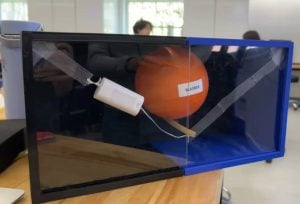
Close up of the linear adjustment region. The black string assists in testing whether the sling can be tightened or loosened.
As they worked toward a prototype, they tackled challenges in the design, such as balancing remote adjustability with patient safety. “Magnetic actuation requires enough force to reliably adjust the sling through tissue but must remain controlled and localized to avoid unintended effects,” said Felipe Aceves, a biomedical engineering major. “This constraint cascades into material selection, encapsulation, long-term durability, and MRI compatibility, making the system much more complex than a traditional static sling.”
After addressing these concerns, they believe that the device will be easy to adjust when necessary and perhaps can even be customized to fit a variety of body types, preventing tension loss or revision surgeries.
The next step for the team is filing for a patent through Johns Hopkins Technology Ventures. They attribute much of their progress to the skills they learned in Multidisciplinary Engineering Design.

The internal hardware of the external remote controller, pictured here without the external case.
“The rigorous process of meeting with patient and clinician stakeholders, prior art searches, robust literature reviews, thorough ideation, prototyping, and testing, all under the guidance and instruction of the teaching team in Multidisciplinary Engineering Design, has imparted on us all a profound understanding of the technical and collaborative skills necessary to succeed in the engineering design process,” Aceves said.