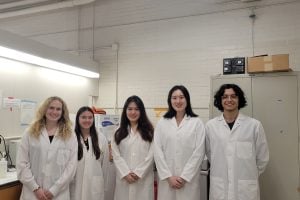
Johns Hopkins chemical and biomolecular engineering students are developing Frontline Seal-48, a wound dressing designed to stop bleeding quickly while providing sustained antimicrobial protection for up to 48 hours.
The students will present their work on April 28 at the Whiting School of Engineering’s Design Day, an annual event showcasing students’ solutions to real-world problems.
Frontline Seal-48 is designed to address a known gap in current military-standard dressings that typically stop bleeding without fighting infection, and individual first-aid kits rarely include materials to prevent wounds from becoming infected. “While there are products that do both, their protection is short-lived,” says Anh Tu (Jenny) Tran. “We focused on creating a formulation that lasts significantly longer—engineered specifically for prolonged care scenarios.”
The team’s design was created in response to a JHubMed initiative led by Colonel Harvey Pynn to address infection and antimicrobial resistance in battlefield and prolonged-care settings. The students chose a “better, not different” approach, to embed a sustained antimicrobial system into a standard hemostatic gauze so medics can use familiar protocols while gaining added protection.
“We wanted to solve a real problem at the point of injury,” says Zoey Bennett. “If evacuation is delayed, stopping bleeding alone is not enough—infection becomes a major risk. The design fits existing wound-care workflows and first-aid kit contents; it is intended to be easy to adopt without extra training or complexity.”
Frontline Seal-48 pairs kaolin-based gauze, which speeds clotting, with silver and copper ions that release over time to inhibit bacterial growth. “When it contacts wound fluid, the dressing helps form a clot immediately,” says Kevin Estevez. “Then the metals release slowly to reduce bacterial growth for hours afterward.” The team says the combined action is intended for contaminated environments and longer evacuation times.
The group described a simple, scalable manufacturing path. “We start with kaolin-treated gauze, then use a soaking and reduction step to bind silver and copper into the material so they’re not just sitting on the surface,” says Claire Fuller. Safety and durability were priorities. “We developed a kaolin shedding test to make sure particles stay in the fabric, and we ran zones-of-inhibition tests to confirm sustained antimicrobial activity. Those checks matter for both performance and user safety.”
Design Center funding allowed the team to expand purchases and run experiments they could not have afforded otherwise. “That support validated our work and gave us confidence to pursue more rigorous testing,” says Zoe Gaillard. The students also prepared a business case, including marketing and operational plans, and competed in the HopStart Medical Technology Ventures category.
The team plans to transfer its experimental findings and data to JHubMed through a Report of Invention at the end of the semester so the design can be developed further. “We’re going our separate ways after this term—grad school, med school and industry—but we want this work to continue,” says Tran. “One of the most motivating and rewarding parts of this project is knowing that our product has the potential to save lives. Colonel Pynn has already expressed interest in using the initial design for training, and we are excited to see how Frontline Seal-48 helps people in the future.”