As demand for lithium-ion batteries, which power everything from electric vehicles to smartphones and grid-scale storage systems, increases, so too does the need for more cobalt and nickel, minerals that are essential to the batteries’ chemistry.
Currently, separating cobalt and nickel from materials involves solvent extraction, a process widely used in mining operations. While effective, the method relies on large volumes of organic solvents and other chemical agents that are environmentally harmful and expensive.
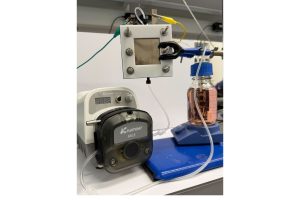
Yayuan Liu, an assistant professor of chemical and biomolecular engineering and associate researcher with the Ralph O’Connor Sustainable Energy Institute, and Tianchen Li, a ChemBE postdoctoral fellow, have identified electrowinning, an electrochemical technique employed by industry in which dissolved copper ions are reduced and deposited as solid metal onto an electrode, as a more sustainable way to separate and recover these metals from mined and recycled materials. A paper describing their results was recently published in Science Advances.
“It’s very hard to create a modern-day lithium-ion battery, an energy source on which we rely so heavily, without nickel and cobalt. Access to large quantities of both metals is critical for the clean energy transition,” says Liu.
Solvent extraction’s limitations are more pronounced in countries—including the United States—where there are few mines that can be excavated for cobalt or nickel. These countries have begun to shift their attention to “urban mining”—recovering critical minerals from end-of-life lithium-ion batteries and electronic waste.
The solvent extraction method doesn’t work as effectively as electrowinning with end-of-life batteries because used batteries contain such small quantities of cobalt and nickel and because they also include multiple dissolved metals—such as manganese, lithium, and sodium—that can interfere with the solvent extraction process.
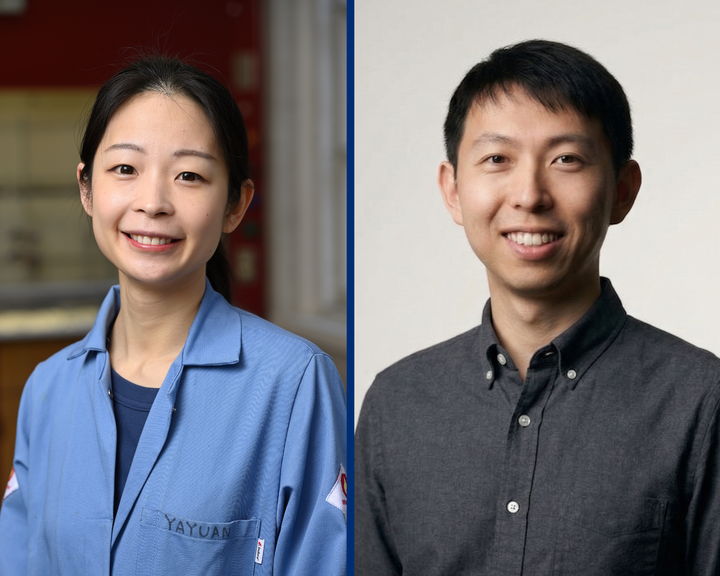
Yayuan Liu (L) and Tianchen Li (R)
“Electrowinning’s edge in urban mining gives us a practical pathway to turn battery waste into a valuable resource for cobalt and nickel, while also helping the United States reduce its reliance on foreign supply chains,” Liu says.
The idea to use electrowinning to separate cobalt and nickel grew out of a collaboration with Michael Betenbaugh, a ChemBE professor and ROSEI associate researcher, who was interested in making battery recycling more sustainable. The most common way to recover metals from electronic waste is to use mineral acids to solubilize the metal ions. The overall idea of the collaboration is to use bioacids —organic acids made through fermentation using microbes – instead of mineral acids for the leaching process. By doing so, Liu’s group made an unexpected discovery: The bioacids didn’t just help dissolve the metals, they also changed the behavior of cobalt and nickel during the next step of the process, electrowinning.
“We tested different bioacids and discovered that when they interact with metal ions, they change their behavior and make the nickel and cobalt separation much more feasible,” Li said.
Among the bioacids the group studied, tartaric acid proved especially effective.
“Tartaric acid forms a very special complex because it has two hydroxyl groups on its carbon chain,” Li says. “It can create a di-nuclear complex, which maximizes the separation factor between cobalt and nickel. Other acids we tested didn’t have that structure.”
The team demonstrated the process in their lab using model battery waste and is now expanding the method to test it on actual batteries and electronic waste streams that contain additional competing ions and more dilute metal concentrations.
“We’re moving toward larger-scale systems and more complex waste materials,” Liu said. “Our goal is to demonstrate that this technology can work in realistic recycling scenarios.”
This article was originally posted by the Ralph O’Connor Sustainable Energy Institute.