Johns Hopkins researchers have developed a new way to test for infectious diseases using everyday handheld glucometers. This innovation aims to simplify the process of measuring antibody levels, making diagnosis more accessible, particularly in places where resources are limited.
Published in Sensors & Diagnostics, this research was a collaborative effort between Jamie Spangler, associate professor of chemical and biomolecular engineering and biomedical engineering, principal author Elysse Ornelas-Gatdula, a doctoral student in the Department of Chemistry, Xinran An, a doctoral student in the Department of Chemical and Biomolecular Engineering, and senior author Netzahualcóyotl Arroyo-Currás, an affiliate of the department who recently moved his lab to the University of North Carolina at Chapel Hill.
Traditional tests that measure antibodies, such as enzyme-linked immunosorbent assays (ELISAs), require expensive and complex analysis equipment that can be difficult to access in remote or under-resourced areas. “We wanted to create a solution that could easily fit into existing health care systems,” says An.
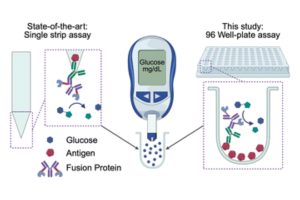
The team’s approach involves using an engineered antibody–invertase fusion protein named LC15. This fusion protein enables detection of disease-specific antibodies in patient samples, using conversion of sucrose into glucose as the signal output, which can be measured directly with affordable glucometers commonly employed in diabetes management. A key innovation of this study was the adaptation of the platform to a 96-well plate high-throughput format that allows for parallel processing to significantly accelerate analysis.
“Unlike traditional ELISAs, our method provides antibody measurements not only at a low cost, but this technology also enables absolute antibody quantification, which is vital for monitoring diseases and determining treatment options,” says An.
One of the primary advantages of this glucometer-based ELISA platform is its simplicity and integration with telehealth systems. With handheld glucometers being widely used and FDA approved, this new method could help streamline the process of antibody testing. “We realized that by leveraging existing technology, we could significantly increase the number of tests processed without compromising accuracy,” says Spangler. This research has important implications for areas with limited health care access. Quick and accurate antibody testing is essential, especially in the face of ongoing global health challenges. The goal is to not only improve individual patient care but also support community health monitoring. By utilizing existing technology, this glucometer platform illustrates how simple changes can lead to significant improvements in health care.
“We want to ensure everyone can access necessary medical tests, no matter where they live,” says Spangler.
This research was financially supported by the Johns Hopkins School of Medicine, the Johns Hopkins University Office of the Provost, Emerson Collective, the National Science Foundation, and the National Institutes of Health.