Seniors in the Department of Civil and Systems Engineering (CaSE) are spending their final year turning classroom knowledge into community-focused engineering designs. The CaSE capstone projects are culminating academic assignments that require teams to address real problems through actionable engineering solutions. The students are divided into two teams according to their major—civil engineering and systems engineering—with both groups working with their designated clients to improve life for Baltimore City residents.
Rehabilitation of a Southwest Baltimore rowhome
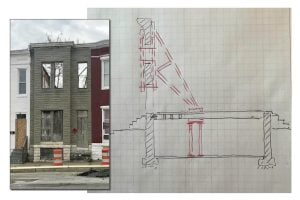
The civil team, which includes Abigail Aranda-Lopez, Wendy Holguin, and Emely Pacheco, is collaborating with Community Law Center (CLC) and Fayette Street Outreach (FSO) on a preservation engineering project at 23 North Smallwood, the site of a vacant rowhome with the front façade as its only standing structure.
The group’s client in this scenario, FSO, provides a community center and neighborhood programs to improve residents’ safety, health, and economic well-being. They are also collaborating with CLC, which acts as a community land trust and revitalizes vacant properties to increase homeownership among city residents.
After the team’s kickoff meeting with CLC and FSO at the beginning of the year, the students were tasked with designing a stabilization and anchorage system to preserve the existing façade and convert the debris- and tree-filled lot into an open-air performance and dance space that’s accessible to residents. During this design phase, CLC is pursuing land acquisition with the hope of eventually providing a complete rehabilitation so that the space can be restored to a home.

From left to right: Abigail Aranda-Lopez, Wendy Holguin, Emely Pacheco
“We met with FSO at the start of the spring semester to ask what they wanted as part of the façade stabilization and foundation design,” said Aranda-Lopez. “In addition to sharing design specifications with us, we found that they really wanted to understand the whole process. That made us begin to think about how things would play out in real-world design development.”
In preparation for developing concept designs, Aranda-Lopez, Holguin, and Pacheco visited the North Smallwood site to complete a condition assessment. Their report concluded that the façade was structurally sound and able to be preserved as part of their final design. With guidance from Professor John Matteo—founder and principal of Matteo Ferran Structural Engineers—the team began collecting site measurements, researching preservation techniques, and building a design matrix to compare several concepts in terms of cost, constructability, feasibility, schedule, aesthetics, and client constraints.
“When we began the project, I was genuinely surprised by how many steps it takes to stabilize a building before it can be used,” said Holguin. “The approach goes beyond engineering. I didn’t think about providing a step-by-step process—from clearing trees in a basement to repointing brick even before reaching the point of building temporary shoring.”
The team’s work has progressed from assessment into preliminary design. In March, they presented a design concept to FSO and are now refining a 3D Fusion model while working through the structural calculations. Their proposed approach includes a reusable shoring system to support the façade, a first-floor platform and foundation system, and a short, protective roof about one-quarter of the length of the house to shelter the shoring system.
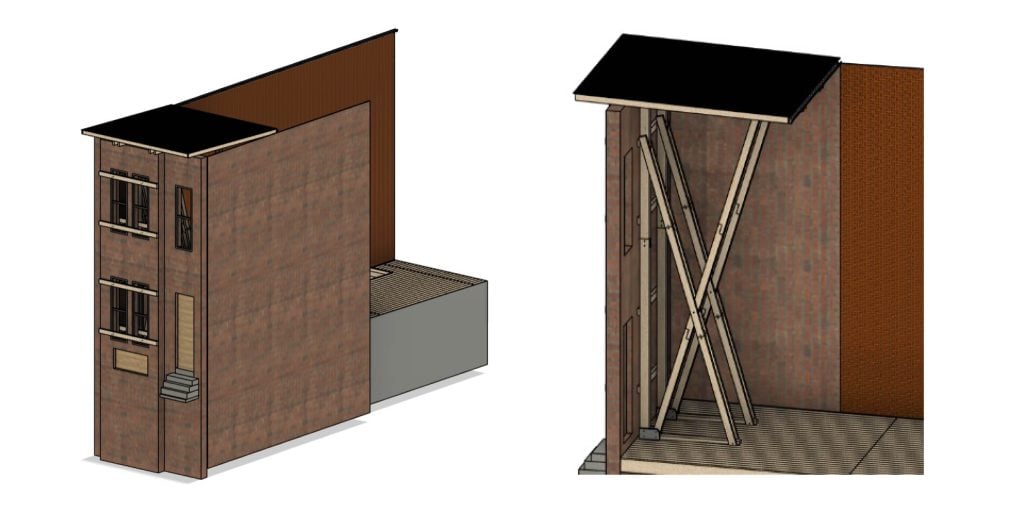
A 3D model of the stabilization design for 23 North Smallwood
The final deliverable package with the group’s condition assessment, drawings, and cost estimates will be usable by contractors and engineering teams should CLC and FSO acquire the land and secure the necessary funding.
“Our client is a nonprofit, so cost matters,” said Pacheco. “Even after we complete our project, CLC will continue to rehabilitate vacant homes, so we’re working towards a sustainable and reusable design that can be used in the preservation of other rowhome façades.”
Optimizing public transit to support Baltimore City high school riders
Systems engineering majors Diana Arizmendi, Benjamin Casino, Charmi Daas, and Diran Jimenez, are tackling a different Baltimore challenge: unreliable public transit for City Schools students. Working with Johns Hopkins University Professor Julia Burdick-Will, whose research shows that frequent bus transfers and unreliable service contribute to low first-period attendance, the group is building an optimization tool that will improve transit routes and ride times for high school students.
“Students who depend on public transit to get to and from school don’t have options that are consistently timely or reliable,” said Jimenez. “There are direct links between reliable transportation and improved academic performance, but neither the Maryland Transit Administration nor City Schools have direct responsibility for a student transit system.”
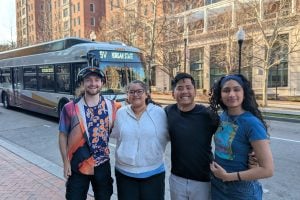
Left to right: Diran Jimenez, Diana Arizmendi, Benjamin Casino, Charmi Daas
The team is using ArcGIS mapping of census tracts and existing bus routes to better understand existing commuting patterns and student rider experiences. They’re now developing and writing the code for a genetic algorithm, an optimization technique that iteratively evolves to find optimal solutions based on specified criteria. The group says that their algorithm combines strong route segments and introduces small random changes based on parameters like stop locations, number of buses in operation, start and end points, travel times between stops, roadway constraints, school schedules, and vehicle capacities. As part of the code, they’ve added penalties for scenarios they want to avoid, such as ride times longer than 60 minutes and multiple transfers.
“We want the solution to be simple and inexpensive to implement, but also flexible so students can adapt if they miss a bus,” Casino said. “We’re looking at scenario metrics, cost analysis, and equity in terms of making sure that times are averaged among riders to prevent one student from having a 15-minute commute while another has a 60-minute commute.”
Arizmendi, Casino, Jimenez, and Daas are evaluating various options to improve the student rider experience, however they anticipate that their final solution will be a combination of modifying MTA routes throughout the city and supplementing routes with dedicated yellow buses, which they say could lead to improvements for other riders.
“Improving student transit would likely have the effect of improving transit for all riders,” said Daas. “Transit affects access to opportunities, and low-income neighborhoods are disproportionately harmed by unreliable service. Our project is focused on high school commutes, but better routes and reliability benefit the whole community.”
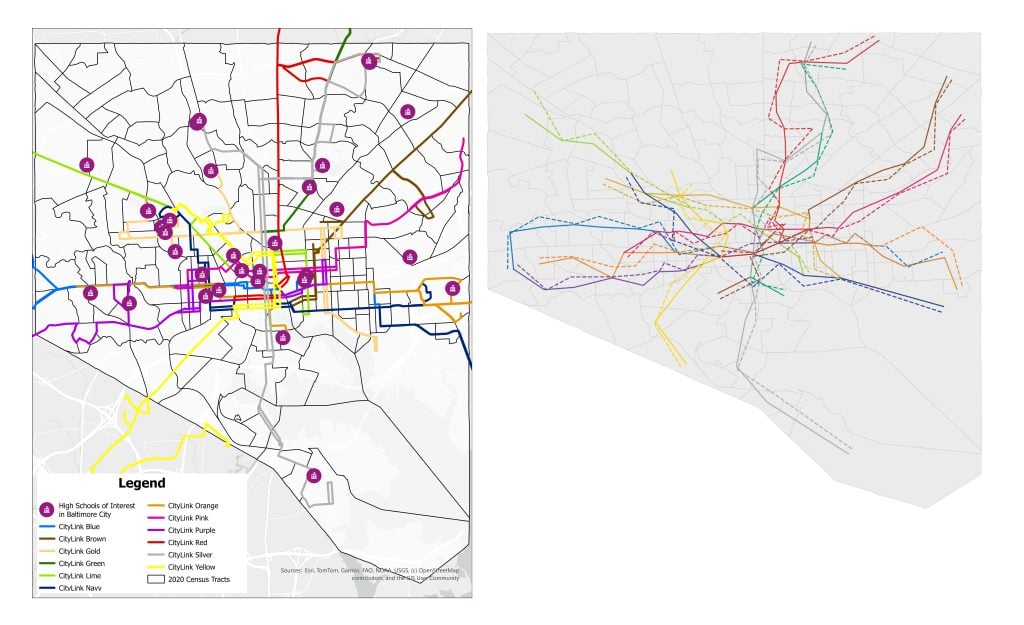
Current bus routes, census tracts, and high schools in Baltimore City (left) and an overlay of current and optimized bus routes (right)
The group says that their genetic algorithm will be transferable, so it can be reused by MTA year-to-year to incorporate changes in student ridership, routes, and driver schedules. It can also be updated to accommodate other parameter changes, like school start times, roadway closures, or even broadening the scope to accommodate middle school commuters.
“Systems engineering is all about the tools you have at your disposal, narrowing parameters, and asking thoughtful questions, so that you can take a large-scale, nebulous problem and design evidence-based solutions,” said Casino. “These can be scaled and applied to almost any challenge.”
Both teams are finalizing their solutions in time for Design Day on April 28, where they will present their methods and final designs. The event is open to the public and attendees are asked to register here.