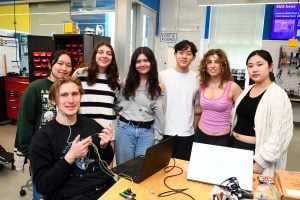
Patients that experience excessive daytime sleepiness related to conditions such as narcolepsy or idiopathic hypersomnia are diagnosed using overnight sleep studies followed by daytime nap tests. A new wearable device designed by a team of biomedical engineering students aims to bring sleep monitoring out of the clinic and into a patient’s daily life.
Designed to be worn during daily activities, the portable in-ear device monitors sleep remotely to improve the diagnosis of sleep disorders. It can sometimes take more than a decade for a patient to get a proper diagnosis. Current testing methods often yield inconclusive results, leading to repeated sleep clinic visits that can be a financial and time burden for both the patient and hospital.
Alternatively, their device could be shipped to the patient and capture more accurate data for longer stretches of time. With a quicker diagnosis, the patient can get the medication or treatment they need to experience relief from their symptoms sooner.
The students will present their project on April 28 at the Whiting School of Engineering’s Design Day—an annual event showcasing students’ innovation and ability to translate theoretical knowledge into real-world solutions.
“The laboratory environment is unfamiliar and intrusive, so performance on the sleep tests does not actually reflect true sleep patterns of patients,” said Christina Liu, team lead and third-year biomedical engineering student. “This is what leads to missed and/or delayed diagnosis and treatment.”
A wide variety of factors can impact their sleep performance such as being sleep deprived, feeling stressed, and disturbance from being hooked up to electrodes.
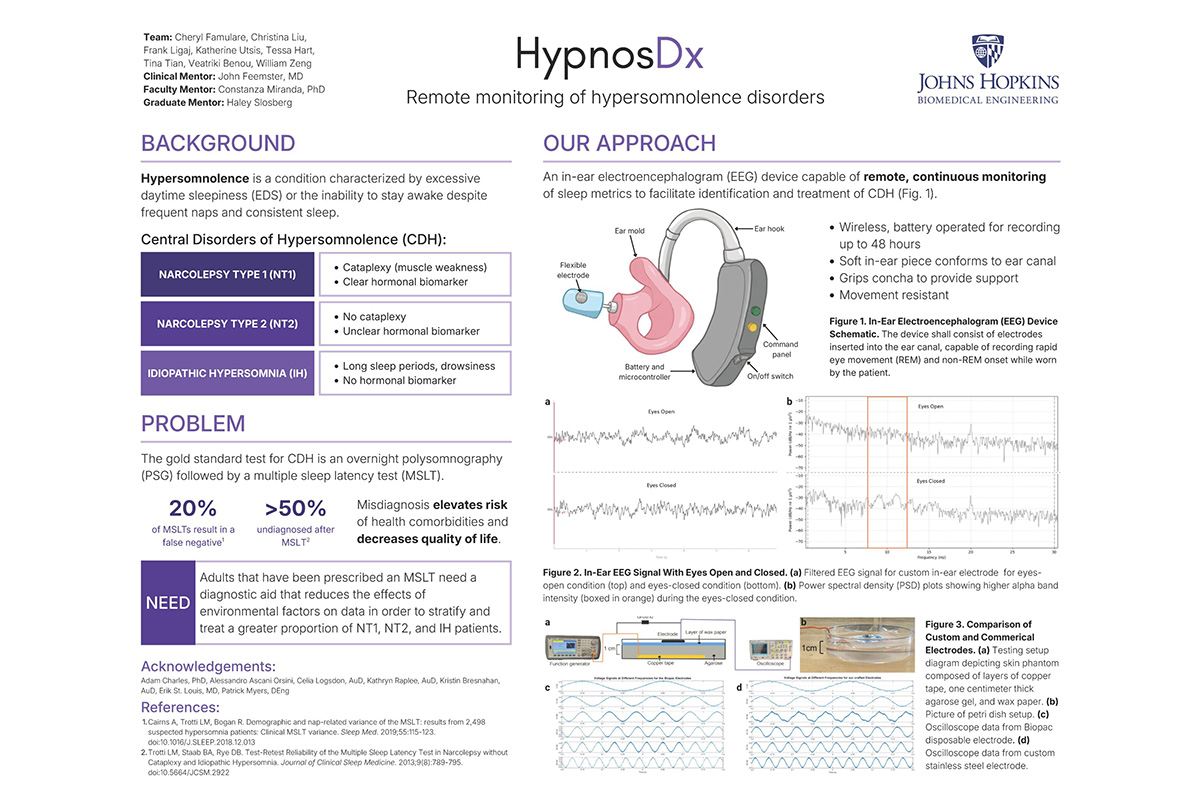
Project Poster
Considering the many flaws of this form of testing, the team created a solution, called HypnosDx, that utilizes continuous monitoring of sleep patterns over a period of more than 12 hours.
“Having the patient wear the device throughout a normal day can better capture episodes of sleepiness that give the clinician a better understanding of what’s going on in the patient’s actual life instead of a lab simulation,” said team member and third-year biomedical engineering student, Veatriki Benou.
The team’s device is designed using flexible electrodes attached to an ear mold that fits like an earbud, while a small control panel, on/off switch, and battery wrap around the helix of the ear.
“The device collects electrical signals from the brain. When analyzed, you can see the markers of different sleep stages and draw conclusions on normal or abnormal sleep patterns,” said team member and third-year biomedical engineering student, Tessa Hart. “The data is processed and stored in a SD card, which can then be shared with the clinician.”
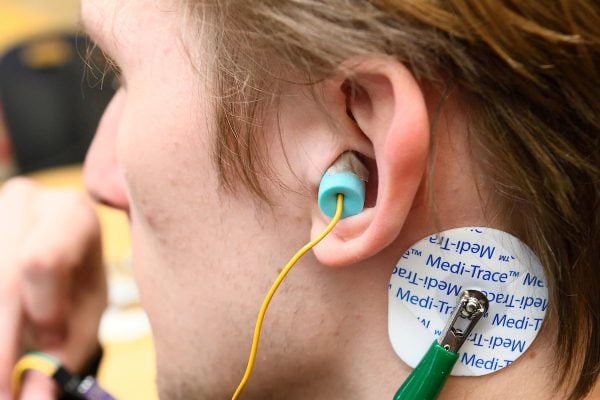
The HypnosDx prototype fits like an earbud, using flexible electrodes to record EEG signals throughout daily activity.
To validate the technology, the team tested the device on skin phantoms—gel models that mimic the electrical properties of the skin—and detected biological microvolt range EEG signals. This result gave the team the confidence that with further amplification and optimization the device will detect stronger EEG signals. Further confirmation came from measuring alpha waves from their device when a subject closed their eyes. This showed the system detects true EEG frequencies and amplitudes, not just noise, and that alpha power changes appropriately with eye state.
The team was advised by Alessandro Ascani Orsini, a PhD student whose research focuses on the use of in-ear EEG. Ascani Orsini, who works in the lab of Nitish Thakor, professor of biomedical engineering, now serves on their advising committee.
As a next step, the team is interested in exploring other applications for their technology. “Our device could have significant applications in the commercial transportation sector. Studies show a substantial number of injuries in large-truck crashes are linked to drowsy driving, and long hours on the road remain the common workday for truck drivers,” said Liu.
The design team also includes Cheryl Famulare, Frank Ligaj, Tina Tian, Katherine Utsis, and William Zeng. Constanza Miranda, associate teaching professor of biomedical engineering, is the team’s faculty mentor, and Dr. John Feemster, a resident in the Department of Neurology at Johns Hopkins Medicine, is their clinical mentor.