
The artificial intelligence revolution is driving up demand for electricity across the PJM Interconnection Region, a regional transmission organization that coordinates wholesale electricity markets in 13 states, including Maryland, plus the District of Columbia.
The increased demand for electrons is sending electricity costs soaring, with grid reliability expected to fall below targets by mid-2027. The growth of data center electricity demand is also showing no signs of slowing, with PJM projected to add almost 30 gigawatts of new demand by 2028 – the equivalent of adding the data electricity demand of Baltimore to the PJM grid each year.
Researchers at Johns Hopkins Ralph O’Connor Sustainable Energy Institute analyzed several of the leading reform efforts, focusing on whether data center flexibility requirements, including the “connect & manage” program currently under consideration by PJM, could put the brakes on rapidly increasing electricity rates and help the grid remain reliably. The findings are detailed in a new report intended to information legislative and regulatory reform efforts across the region as policymakers try to thread the needle on securing the economic benefits of the AI revolution without raising costs for consumers or diminishing grid reliability.
“Our analysis demonstrates that requiring data centers to accept occasional power interruptions saves over $15 billion per year for the whole PJM region. If we translate these savings into each customer or household, it would be roughly $200 for every person in PJM, or about $1,000 for every household,” says Yury Dvorkin, a core researcher with ROSEI who is also an associate professor of electrical and computer engineering and civil and systems engineering. “These savings can be realized if we find a way to coordinate data center and power grid operations.”
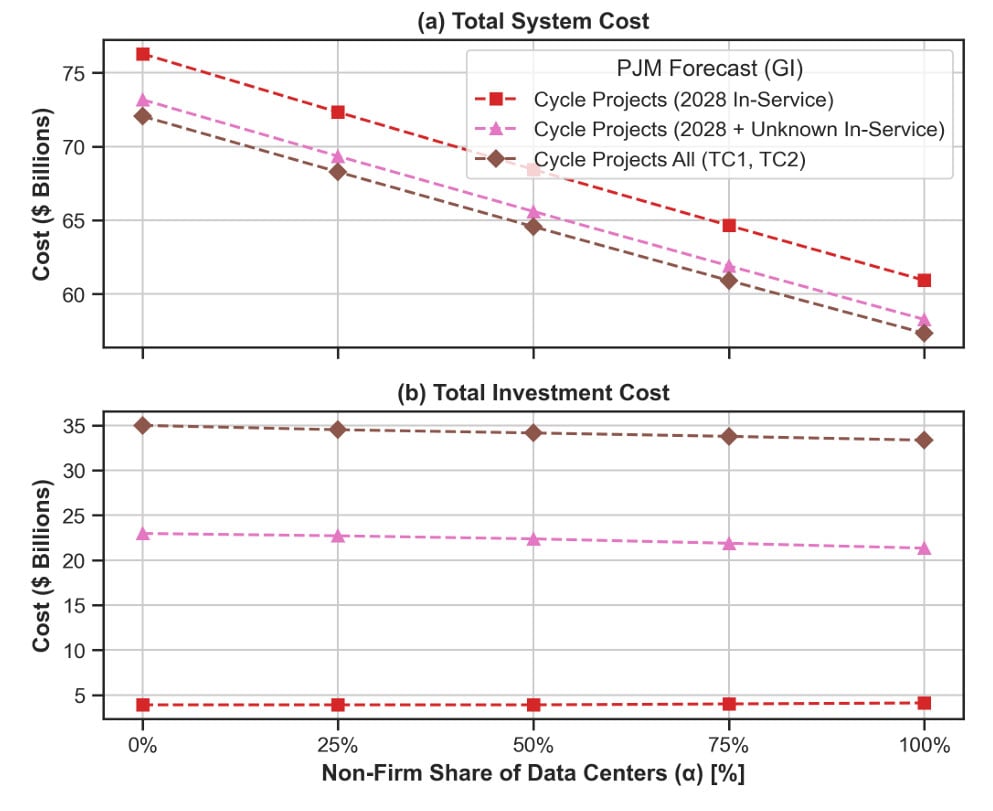
Increasing data center flexibility dramatically lowers total system costs across all scenarios, with minimal impact on overall investment—highlighting flexibility as a key driver of savings.
Data centers are currently served under a firm service model, which means the grid must be able to provide whatever power center needs at any time. Maintaining that level of service requires significant investment in generation and infrastructures such as new and upgraded power plants—which raise costs that ultimately get passed down to consumers.
ROSEI’s researchers found that focusing on how data centers connect to the grid could be a far more effective and cost-efficient solution to reliably meeting energy requirements than building new power plants. With a non-firm service, data center operators could agree to reduce or pause their electricity use when the grid is strained.
“We find that not only are total costs lower under the ‘connect & manage’ plan, where data centers connect to the grid and are managed with non-firm service, but there is a significant shift in how we use our money – with more invested in new grid resources and less going to existing generators,” says Abe Silverman, a research scholar with ROSEI. “A flexible approach delivers much larger savings than simply adding more generation. How we structure demand—especially for new, energy-intensive users—can matter more than how much supply we build.”
Importantly, the study also shows that these reductions—known as curtailment—can be both predicted and manageable. In their models, the total amount of curtailed energy remained consistent across scenarios, indicating that the risk of mass blackouts is driven by how service is structured, not by a lack of generation.
“The curtailment data centers would face isn’t random or chaotic—it’s consistent and foreseeable,” said Saroj Khanal, an ECE PhD candidate in Dvorkin’s lab group. “It’s a function of the service design, which means it can be planned for and managed effectively.”
The group notes that service design is particularly important as it helps strike the balance between the power grid and the interests of data centers. If operations are interrupted too often, data center developers will look elsewhere to build. Therefore, it is essential to understand how economic signals can help leverage flexibility – from smart AI workload allocations to thermal management of data center.
“Understanding how data centers consume electricity on the scales from a single graphics processing unit, to a rack of GPUs, to the entire data center cooling system, which is based on very complex physics, is critical for designing an appropriate non-firm service framework,” said Ján Drgoňa, a core researcher with ROSEI who is also an associate professor of civil and systems engineering.
According to the group, it is critical that these changes be implemented soon given that the region is now facing its largest ever surge in electricity demand in the past several decades.
“We’re entering a period where demand growth is outpacing the traditional ways we plan and build power systems,” Dvorkin says. “Decisions made today will lock in infrastructure costs for decades, and incorporating flexibility into how new loads are served isn’t just an option—it’s one of the most practical and cost-effective tools we have to ensure the grid can keep up.”