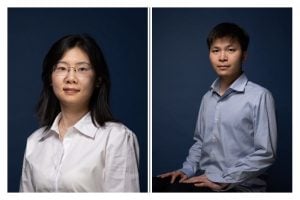
Two Johns Hopkins engineers are among 28 early-career researchers highlighted in the inaugural list of Young American Scientists selected by Scientific American. Both engineers focus on biomedical research in the life sciences.
The two from Hopkins are Jieneng Chen, who received his PhD in computer science this year, and Xiao Yang, an assistant professor of biomedical engineering.
The researchers were nominated by leading scientists from around the world, and the final set of honorees were chosen by Scientific American editors. According to the magazine’s announcement, the early-career researchers are “burgeoning luminaries in American science … advancing breakthroughs with real-world impact.”
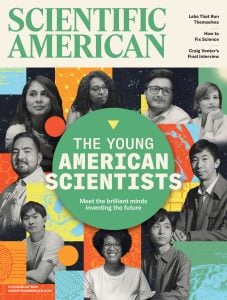
July/August issue cover of Scientific American
Illustration by Max-o-matic, Photographs by Jeffery DelViscio, Christie Hemm Klok and Tony Luong
Jieneng Chen received his PhD from the Department of Computer Science earlier this month. Working with Bloomberg Distinguished Professors Alan Yuille and Rama Chellappa, Chen’s work focuses on artificial intelligence, computer vision, multimodality, embodied AI, and medical AI. His seminal work, TransUNet, integrated transformers (deep learning neural networks that power generative AI models) into biomedical image analysis. He has used AI to tackle health inequities and developed the first AI model capable of diagnosing eight common cancers. He was a 2025 Siebel Scholar, an early-career recognition for students in bioengineering fields. Chen recently moved to Stanford to pursue postdoctoral research. Read the Scientific American profile of Chen.
Biomedical engineer Xiao Yang joined the Johns Hopkins faculty in 2025. She develops bioelectronics and biomaterials for broad applications in brain-machine interfaces, regenerative medicine, and the study of human neural development and diseases. Her recent work takes inspiration from the ancient paper-folding art of kirigami. Yang uses the flexible qualities of the paper-folding art form to design electronics that transform into 3D structures that can integrate with complex human brain models and other mini-versions of living tissues, known as organoids. These tools, she says, will provide researchers with a new way to more accurately study organoid models of neurological conditions, including schizophrenia and autism spectrum disorder. Read the Scientific American profile of Yang.
This year’s honorees are featured in profile stories and select in-depth interviews featured in digital and print issues of the magazine.
An inside look into Yang’s lab and work is featured on YouTube.