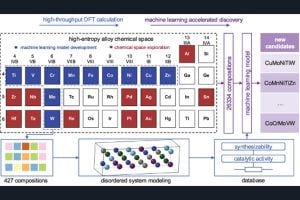
A team of researchers in the Department of Materials Science and Engineering at Johns Hopkins have developed an artificial intelligence framework that can predict the properties for a certain class of alloys called high-entropy alloys (HEAs). Their goal is to find an alternative to platinum, a rare element, to accelerate the development of hydrogen fuel cells for commercial use. Their work, “The search for high-entropy fuel-cell catalysts using disorder descriptors,” is found in Nano Futures.
“Hydrogen fuel cells convert hydrogen and oxygen into electricity and water, providing power that is clean and reliable,” says project leader Corey Oses, an assistant professor of materials science and associate researcher at the Johns Hopkins Ralph O’Connor Sustainable Energy Institute (ROSEI). “Hydrogen power is incredibly important at an industrial level, as it can be used in long-haul trucking and forklifts. We want to commercialize hydrogen so regular consumers can use it, making it the most affordable choice over traditional fuel.”
There’s just one problem—the conversion from hydrogen to energy requires a catalyst containing platinum, an expensive, rare metal.
“We want to find an alternative to platinum, so it’s financially feasible for consumers to someday make the switch to hydrogen power,” says Oses. “High-entropy alloys are the best option, because they are made of many components that might be able to mimic or even exceed the emulator, out-performing a material like platinum.”
To find out, they needed to discover which HEA combinations would perform better than platinum. The team decided to create an AI framework to predict which combinations would work best as a replacement for platinum.
“We want to quickly screen more compositions and generate rapid predictions, so we wondered if we could teach an algorithm these properties and then integrate it into a machine learning framework,” says Oses. “And the answer is yes, we can.”
Using quantum mechanics-based calculations—specifically density functional theory (DFT)—they employed several methods, called disorder-sensitive descriptors, to describe these materials computationally and then fed it into the intelligence framework. One of these measures, called the disordered enthalpy-entropy descriptor (DEED), is particularly effective at predicting whether certain materials can be combined into a stable, complex alloy. They also assessed if stable alloys could form between certain combinations of elements.
“Some of these descriptors are easier to calculate, and some are much more challenging,” says Oses. “We were interested in seeing if the easier ones, which can be calculated using a calculator and referencing the periodic table, were correlated with the complex descriptors, which can only be found using DFT. Surprisingly, they are loosely related; the descriptors overlap and show that simple descriptors, which typically miss detailed electronic interactions, can still be useful in finding new materials—even if we can’t directly use them.”
The researchers aim to move this project forward by modeling alloys with different structures. “This work focused on a crystal structure called body-centered cubic, which is one of the predominant phases of HEAs,” says Oses. “To get the most accurate analysis of a potential new material, we need to study all the different atomic arrangements a material can have and compare them to one another.”
They also want to make this process closed loop, so the top predictions can be made into experiments that improve the model’s accuracy.
“In the future, we would want to use this technology to see which top predictions meet expectations when they are modeled experimentally and then feed that result back into the model to make predictions that are based on both calculations and experiment,” says Oses. “This innovation could save us time and money while accelerating the discovery of new materials to take the place of platinum in hydrogen fuel cells.”
Oses collaborated with Guangshuai Han, a postdoctoral fellow at ROSEI; PhD students Tianhao Li, Xiao Xu, Jaehyung Lee, Guotao Qiu, and Sabrina Sequeira; and third-year Akshaya Ajith, all in the Department of Materials Science and Engineering.