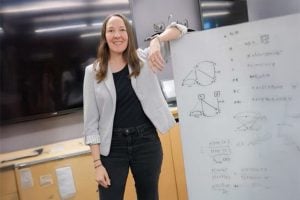
At Johns Hopkins, Alexis Battle is leading the charge in harnessing artificial intelligence to decode the complexities of cancer and other diseases. With her expertise in machine learning, Battle is working to sift through vast amounts of genetic and clinical data, revealing hidden patterns that can inform treatment strategies and improve patient care. By developing sophisticated AI models in collaboration with the Kimmel Cancer Center, she aims to predict patient outcomes and treatment responses with unprecedented accuracy. This interdisciplinary effort leverages insights from engineering, medicine, and data science and promises to transform cancer research and care, ensuring that personalized, precise treatments are within reach. As Battle emphasizes, AI is not about replacing the human touch but enhancing it, equipping doctors to meet the challenges of modern medicine head-on.
To Alexis Battle, artificial intelligence is not the medicine of tomorrow, but a powerful tool already at work today, beginning to help doctors and researchers decode hidden clues about cancer and other diseases that would be impossible for any human to detect alone.
“Every patient’s disease is a moving target,” says Battle, a professor of biomedical engineering and computer science, the director of the Malone Center for Engineering in Healthcare, and director for research strategy and partnerships at the Data Science and AI Institute at the Whiting School of Engineering. “It changes over time—from diagnosis to treatment to remission or sometimes recurrence. Add in imaging, lab tests, genomics and clinical notes, each coming from different parts of the body over time, and it becomes clear that the sheer volume and complexity of this data makes it impossible for any single person to see all of the patterns and piece it all together. This is where AI can help.”
AI, she explains, is not just recent AI tools in the press—AI is more broadly the performance by computers of tasks that are traditionally associated with human intelligence, and that includes everything from complex reasoning, use of human language, visual recognition tasks, artistic and creative activities, planning and learning from experience.
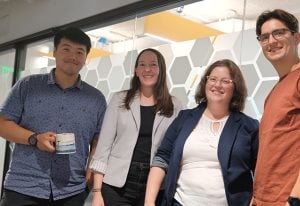
From left to right: Bohan Ni (CS PhD student), Alexis Battle, Rebecca Keener (BME research scientist), Graydon Moorhead (CMDB PhD student)
Bringing Experts Together
Alexis Battle is an expert in machine learning, a type of AI that teaches computer systems to automatically identify complex patterns from data. She has devoted her career to building and training AI models that can see through the convoluted sea of data to create order from chaos. With training in computer science and experience at Google, she turned her expertise toward human genetics and genomics to inform health, including cancer.
“I really wanted to be doing something with the technical knowledge that I had built in machine learning that I felt could contribute to human health,” she says.
By applying machine learning, her lab is focused on a better understanding of how genes interact with each other and how individuals’ genetic differences influence health and disease. These insights are already informing the understanding of heart disease, rare childhood disorders, autism, and cancer.
What sets Johns Hopkins apart, she says, is the broad expertise and how people from seemingly different worlds—engineering, computer science, applied math, biology, public health and medicine—come together. Many Malone Center faculty straddle engineering and medicine, creating a shared desire to solve real problems in health. This collegial environment, Battle believes, is unique.
“I came from industry, but I’ve been at Johns Hopkins for more than a decade,” she says, “It’s a place where people from across so many disciplines so readily sit down together to work through problems. This collegiality is combined with a scientific environment of very high standards and rigor. We innovate as an institution.”
Fine-Tuning AI for Cancer Care
One recent project illustrates what’s possible with this kind of interdisciplinary collaboration. Working the faculty at the Malone Center and the Kimmel Cancer Center, Battle joined Mathias Unberath to help fine-tune a large language model—a type of AI program that learns patterns of words, sentences, and meaning from massive amounts of text—using structured electronic health record data. The model was trained to follow patient trajectories, learning how a diagnosis at one point in time might predict future outcomes, including treatments, side effects, or complications.
This work, initiated through the Cancer AI Alliance (CAIA), preserved patient privacy through what is known as a federated system. Put simply, this means that Johns Hopkins data can inform cancer research without ever leaving the institution. The Kimmel Cancer Center and Whiting School of Engineering are founding members of CAIA, which is under the leadership of Vasan Yegnasubramanian and Battle.
“It shows the potential of tailoring large AI models specifically for cancer patients,” Battle explains. “This particular project, pulled together under an aggressive timeline, was a deeply collaborative effort, one that drew in faculty, students, research IT, and the Data Science and AI Institute’s research software engineering team.”
From Rare Variants to Common Diseases
Much of Alexis Battle’s research centers on variations in the human genome. While some genetic variants are common, many are rare—sometimes observed in a single individual. However, by using AI, these seemingly rare variants can be found and deciphered among large populations of people. Her lab builds machine learning and AI models to understand the effects of those unique changes.
Our DNA is spelled out in a four-letter code—A, T, C, and G, each representing a different chemical. A gene variant is a change in that code. Sometimes it’s just one letter switched for another, like a typo in a word. Other times, a letter might be missing, an extra one added in or even a stretch of the code is repeated. This four-letter alphabet carries the instructions that cells need to build proteins and keep people’s bodies working. The sequence makes every individual unique, but it also forecasts health differences and disease processes. For example, she explains, a rare change of a letter in the ATCG genetic code could flip a nearby gene on at the wrong time, making a person susceptible to a disease or even revealing a disease-protective mechanism.
“It is different from person to person, and we don’t know most of the mechanisms,” she says. “These genetic changes interact with different environments too. For example, a change could make one person more susceptible to cigarette smoke exposure, while making others more resistant to the exposure.”
This type of research has immense impact on understanding and treating human diseases, including cancer, and some of these rare genetic mechanisms may point directly to therapeutics. However, these variant patterns and the potential for drugs to intercept the harm they might cause—or protection from disease they might confer—would be much more difficult to identify without the aid of artificial intelligence.
“Although these differences can help answer why some people exposed to risks stay healthy while others develop disease, they also shed light on why only some cancers respond to treatment and why others are resistant,” says Battle. “Exploring this space so fully and quickly was a challenge 15 years ago, but now, we finally have the tools to make progress.”
An Investment in Patients
The scale of this work is enormous. Collecting genome sequences, imaging, lab data and clinical histories across large patient groups—and training AI to interpret it all—is not a small endeavor. It requires major investments in data, computing power, and teams of experts.
Battle is candid. She acknowledges that funding major new initiatives is a challenge, but she believes an investment now could be transformative with a payoff of stronger science and, most importantly, better care for patients.
The Right Place
For Alexis Battle, Johns Hopkins is the right place to lead this revolution. The breadth of expertise, the culture of collaboration, and bold institutional investments in data science and AI have created fertile ground.
“We’re already using AI in some parts of cancer care detection and treatment,” she says. “New efforts will allow us to move from slower, incremental steps to a new speed and energy. The potential is enormous.”
Her message is one of both realism and hope. She does not believe AI will or should ever replace the human touch in medicine, but by giving doctors a powerful new tool, they can meet the complexity of disease with precision treatments tailored to each patient.