Opportunities That Are Uniquely Hopkins
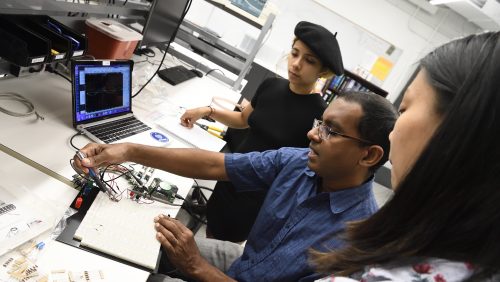
Integrating research and education and the creation of knowledge are the hallmarks of Johns Hopkins University. As an undergraduate here, you’ll have the chance to be part of this rich tradition, beginning your first year on campus.
With unrivaled opportunities to work one-on-one under the mentorship of engineering faculty members, clinicians at Johns Hopkins School of Medicine, and researchers at the Applied Physics Laboratory, participating in research is an important part of the Hopkins undergraduate experience. In fact, 70 percent of our undergraduates take part in research, outside their classes.
By joining a research team, you can deepen your connections with the university, explore career options, and not only learn about, but be part of, breakthroughs that advance knowledge. Our undergraduates contribute to journal articles, attend professional conferences, and some can earn academic credit for their work.
Your Time to Explore: How to Find Research Opportunities
- The Hopkins Office for Undergraduate Research offers resources and events to help you get started, including a step-by-step guide that outlines the entire process.
- Your faculty advisor, other undergraduates and graduate students, and your department may be able to offer options.
- Learn what faculty are doing. If you find something that interests you, contact them!
Research and Resources for JHU Undergraduates
- RISE@APL (Research Internships in Science and Engineering) provides competitive, paid summer research internships
- The Provost’s Undergraduate Research Awards (PURA) program supports research and other creative projects
- Johns Hopkins Medicine Summer Internship Program provides research opportunities in laboratories at Hopkins Medicine
- Vredenburg Travel Fund supports international undergraduate research, internships, and service work during the summer.
- The Bloomberg Distinguished Professorships summer fellowship program gives Johns Hopkins undergraduates the opportunity to work and conduct research under the mentorship of some of the world’s preeminent scholars.
Summer REU Options @ Johns Hopkins
These opportunities are open to current JHU students as well as undergraduate students from other colleges, universities, and institutes.
Computational Sensing and Medical Robotics
The REU program in Computational Sensing and Medical Robotics (CSMR) is an intensive, ten-week program of laboratory research and instruction, beginning end of May and concluding in early August. Projects are listed by departments including Electrical and Computer Engineering, Mechanical Engineering, Biomedical Engineering, and Computer Science.
Materials Growth and Engineering
A research experience for undergraduates (REU) position is available at the Platform for the Accelerated Realization, Analysis, and Discovery of Interface Materials (PARADIM) bulk crystal growth facility located on the Johns Hopkins University (JHU) Homewood campus in Baltimore, Maryland.
PROPEL (Program for Research Opportunities in Engineering Leadership) is designed to increase exposure to research careers and graduate education for undergraduate students from diverse backgrounds
Eight weeks of hands-on research in a molecular modeling and design laboratory, developing new algorithms and discovering new science.
Nanotechnology for Biology and Engineering
The Institute for Nanobiotechnology at Johns Hopkins University offers undergraduate students from colleges and universities around the country a chance to participate in research projects in the exciting and rapidly growing area of nanobiotechnology, a place where biology, medicine, and nanotech meet.
The JHU BioREU is a Research Experiences for Undergraduates site funded by the National Science Foundation. The10-week summer program is designed to provide an intensive, mentored research experience for undergraduates, especially those attending institutions with limited research opportunities. The focus of the REU program is visualization of macromolecules in biological research.
Multi- institutional partnership providing research opportunities for) students with the Materials Science in Extreme Environments University Research Alliance (MSEE URA), a basic research program focused on understanding and mitigating the effects of chemical, biological, and nuclear weapons of mass destruction.
This eight-week workshop provides an intense, dynamic intellectual environment. Undergraduates work closely alongside senior researchers as part of a multi-university research team, which has been assembled to attack current Human Language Technology challenges.
Amgen Biomedical Science and Biotechnology
This summer research program in science and biotechnology aims to provide undergraduates with the opportunity to engage in hands-on research. The Amgen Scholars selected will receive a competitive summer stipend and be housed near the Hopkins campus, in a research community with other summer researchers.
The PARADIM Materials Discovery REU is a 10-week summer program designed to provide an intensive, mentored research experience for undergraduates, especially those attending institutions with limited research opportunities. The PARADIM Bulk Crystal Growth Facility is located at Johns Hopkins University. Together with the thin film growth facilities at Cornell, it provides unprecedented capabilities for discovery of new materials and interfaces.
The Hopkins Extreme Materials Institute (HEMI) and the Maryland Institute College of Art (MICA) are pleased to host the Extreme Arts Summer Project/Internship. The goal of this project/internship is for a MICA student to collaborate with HEMI researchers to explore visual representations of the HEMI organization, structure, current research, and relationships.
Design Day
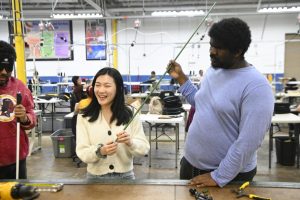
The Johns Hopkins Engineering community is creating a better future, translating theoretical knowledge into real-world solutions. Design Day is our annual celebration showcasing student innovation and creativity.
“Overcoming obstacles is what makes research research. It’s the very essence of the creativity that’s necessary for devising solutions. ”
 Rayyan Gorashi ’19
Intern (Belgium), INBT International Research Experiences for Students
Rayyan Gorashi ’19
Intern (Belgium), INBT International Research Experiences for Students