Imagine telling a computer, “I want a material that is hard, durable, and conducts electricity at room temperature without giving off extra heat,” and having it hand back an idea to test in the lab. That’s the goal of a growing area of AI research called “inverse materials design,” a field of study where researchers give AI algorithms with prompts on the qualities and functions they want from a material, and the AI tool works backward to provide options the scientists can test in the laboratory.
Several companies and research labs have created models to provide such reverse-engineering guidance, but a team from Johns Hopkins and West Virginia University says it’s hard to know what aspects of the models works well.
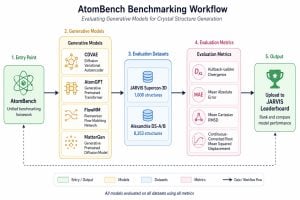
To compare the models, the research team created AtomBench to explore the models’ methods and rank their ability to inform scientists.
A description of AtomBench is published this month in the Royal Society of Chemistry’s journal Digital Discovery.
Until now, materials science has worked in one direction: scientists study a material’s atomic structure, then use experiments or computers to investigate the substance’s properties – hardness, conductivity, magnetism. This process has enabled materials scientists to create stronger metals, better batteries, and safer medical implants, but the process of material design can be slow and starts with materials that already exist. With inverse materials design, researchers may be able to use AI models to reverse-engineer that process, going from property to structure.
“In recent years, it feels like AI has gotten its PhD in materials science,” says Kamal Choudhary, an assistant professor in the departments of Materials Science and Engineering and Electrical Engineering and Computer Science at Johns Hopkins and leader of the research. “AI models could soon reach a Nobel laureate level of science. Our goal is to help every lab feel like they have a Nobel laureate at their fingertips.”
For the current study, the team focused on superconductors — materials that, below a certain temperature, conduct electricity without the resistance and heat that most materials emit when conducting electricity.
Choudhary says that finding a superconductor that works at room temperature could transform the sustainability, efficiency, and cost of power grids and electronics. Finding one, though, means searching an infinite number of potential materials.
Choudhary and the team tested four AI models for materials design — CDVAE, developed by MIT researchers, FlowMM from MetaAI and the University of Amsterdam, MatterGen from Microsoft Research AI, and one they developed, AtomGPT. Each model uses different approaches to solving materials design problems and analyzing data.
The team then gave the models the same task: take the chemical composition for a superconductor and predict the spatial positions of its atoms.
The models were grouped by the number of prompts needed to level the playing field before making their predictions.
The results did not identify a clear winner.
Microsoft’s MatterGen was the most accurate at placing individual atoms correctly, with Choudhary’s AtomGPT a close second. CDVAE was the best at reproducing the overall shape and size of the structure, and Meta’s FlowMM was the fastest but trailed the others in accuracy.
Choudhary says one of the results that surprised him was that MatterGen achieved its prediction in atomic accuracy with about 140 times fewer parameters than the ones researchers gave AtomGPT. The researchers attribute this to MatterGen‘s training: it was trained on large databases of real molecular structures and built with physical constraints baked into its architecture.
AtomGPT uses a model similar to popular AI models ChatGPT and Claude which employ a large language model algorithm to process human language. For Choudhary, what this means is that a smaller model trained with the right knowledge and physical “common sense” constraints, like MatterGen, can outperform a much larger general-purpose model trained on more data, which he believes is a finding with implications beyond materials science.
The team’s goal, they say, is to make the comparative information useful to materials scientists.
The project’s first author, Rhys Campbell, began this work as an undergraduate intern in Choudhary’s group at NIST. Campbell will join Choudhary’s lab at Hopkins as a PhD student this fall.
“Creating a new statistical metric to evaluate these models and using information theory to determine if the models are being fairly compared was my favorite part, and empirically validating these theoretical developments was quite satisfying,” says Campbell, who recently received his bachelor’s degree in physics from West Virginia University. “I can’t thank my mentors, Kamal Choudhary and Aldo Romero, enough for guiding me through this process and teaching me how to think like a researcher.”
The open-source AtomBench tool is available to scientists. Choudhary is continuing to develop AtomGPT with the goal of making it “a ChatGPT for superconductors” and potentially other materials. Users can enter a chemical formula and a target temperature at which they’d like their superconductor to work and the tool provides a possible structure.