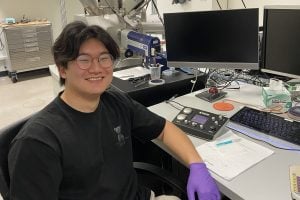
A team including Johns Hopkins materials scientists have optimized a set of processing routes to enhance the mechanical and corrosion properties of biodegradable bone implants. This class of implants seeks to degrade in the body at a rate that matches the healing of bone, helping to mitigate the effects of bone loss typically associated with permanent titanium or steel implants and, thus, removing the need for additional surgeries. Their findings will be presented at The Minerals, Metals, and Materials Society (TMS) Annual Meeting and Exhibition and has been published in the meeting’s supplemental proceedings in March 2026.
“Current implants can cause stress shielding, a condition that causes bone loss and therefore increases the risks of fracture and additional surgeries to fix,” says Andrew Kim, fourth-year materials science and engineering undergraduate student on the project. “Stress shielding stems from the implant carrying the load from daily movements like sitting, standing, and walking. We want to avoid this in our biodegradable alloys by selecting materials that better match the intrinsic properties of human bone and implement thermomechanical processing to tune their strength and corrosion resistance properties,” he says.
The researchers applied various processing methods to a magnesium-calcium alloy. This alloy is favorable to use as a biodegradable implant material as its simplified chemistry presents less cytotoxicity risks, and as calcium is a critical element used to support bone.
“We want to balance the alloy’s mechanical performance and its corrosion resistance,” says Sreenivas Raguraman, PhD student in the Department of Materials Science and Engineering and Kim’s mentor on the project. “These alloys need to provide sufficient strength and structural support during the healing period, while also degrading at a controlled rate in the body. At the same time, we do not want an implant that is excessively stiff compared with bone, because that can lead to stress shielding.”
The team applied several commonly used processing techniques to a magnesium-calcium alloy to understand how each step influences performance. These methods included extrusion, which presses the metal at high temperatures through a precision tool called a die; rolling, which reduces thickness by compressing the material; Equal Channel Angular Pressing (ECAP), which refines grain size through severe plastic deformation; and annealing, which involves controlled heating to modify the material’s microstructure.
“Extruded samples were set as our baseline reference condition as it is a process regularly used in developing medical devices.” says Kim. “Between the extruded and ECAP samples, batches from each condition underwent rolling, annealing, and a combination of rolling and annealing. This set of processing routes was used to determine how each step would impact the materials mechanical and corrosion properties, alongside their combined effects.”
Then, Raguraman viewed the most processed alloy using Electron Backscatter Diffraction (EBSD) on a scanning electron microscope, to see how the smallest crystal structures in the alloy changed due to processing techniques.
“When we examined the alloy processed through the most effective pathway, we observed a clear refinement in grain size compared to the initial extruded condition,” says Raguraman. “This sample had finer and more uniformly distributed grains, which are known to strengthen metals.”
The improvement in strength comes from changes at the microscopic level. The processing steps increase defects known as dislocations and make it more difficult for them to move, while the refined grain structure further strengthens the material.
“We discovered that the alloy strength increased by 50 percent, which was a significant and surprising finding,” says Kim. “Importantly, the corrosion rate did not significantly change, showing that we can improve mechanical performance without compromising how the material degrades in the body.”
The teams seek to conduct further advanced characterization of the alloy to better understand the mechanisms behind the combined processing effects. Additionally, they wish to conduct corrosion-fatigue tests on the alloy, which mimics the combination of cyclical loading and degradation the implant would experience within the body.
This work was completed under the guidance of Tim Weihs, professor of materials science and engineering at Johns Hopkins. The team collaborated with Adam Griebel, senior research and development engineer at Fort Wayne Metals. The work was funded in part by the Johns Hopkins University Provost’s Undergraduate Research Award (PURA), which Kim earned earlier this year, and a research grant from the National Science Foundation.