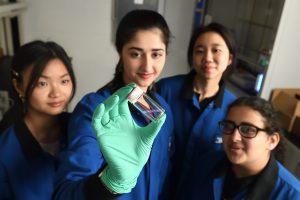
Earlier this year, a group of engineering students gathered around a hot pink and purple friendship bracelet maker decorated with stars. They weren’t doing arts and crafts but rather taking inspiration from the bracelet maker to try to solve a painful and often overlooked problem facing some cancer patients.
The group, helmed by undergraduate materials science students Sydney Kanuga and Mareham Yacoub, set out to develop a biodegradable pancreatic and bile duct stent for patients healing from one of the most complex types of surgery for cancer: the Whipple procedure.
The procedure removes part of the pancreas, the first section of the small intestine, the gallbladder, and the bile duct, usually because the patient has pancreatic cancer or an intestinal tumor or something similar.
“Your gastrointestinal tract is basically one long tube that passes through multiple organs. So, if you have cancer in any of those organs, a surgeon will want to cut out the cancerous part and then literally stitch together the remaining portions of your GI tract,” Kanuga explained.
To connect the GI tract, surgeons may place a stent, often a small silicone tube, along parts of the tract, acting as a kind of scaffolding to enable the GI tissue to regrow and heal.
Once the tissue regrows and heals, the stent passes through and out of the GI system. “A lot of the time, the stent gets lodged and causes pain, inflammation and infection, and they have to do another surgery to remove it,” said Yacoub. The question the group asked was: ‘What if that tube could be biodegradable and just melt away on its own once you’ve healed?’
How They Made It
Kanuga and Yacoub started with FDA-approved biodegradable sutures, because they already had an idea of how fast they would degrade. Looking for ways to braid the sutures into a tube, Kanuga turned to one of her favorite television shows.
“There’s an episode on How It’s Made of how to make climbing rope,” she said.
Climbing rope, made with a sophisticated weaving machine, has a solid core that gives the rope strength surrounded by decorative neon fibers to make the rope visible in the wilderness. Kanuga’s idea was to wind sutures around a central form and then dip the sutures in a biodegradable polymer to hold them in place. Then, they could remove the central form, leaving the sutures shaped like a tube.”
To weave the sutures together the students looked to an unlikely place: friendship bracelets.
“I ended up on Amazon, and I found a $30 friendship bracelet maker that had a mechanism actually very similar to the one I saw on How It’s Made, but just much smaller,” said Kanuga.
The hot pink and purple gadget was called “The Cool Maker.” It uses an ancient Japanese braiding technique called Kumihimo. This form of braiding could help the team easily tune the density of the braid to control its sturdiness.
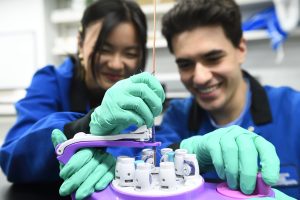
The Cool Maker. Photo by Will Kirk.
One of the design team members created a way to do Kumihimo braiding without the Cool Maker, using just a cardboard disc.
Once they had a sturdy braid of sutures, they coated them in polycaprolactone, an FDA-approved biodegradable polyester commonly used in medical devices.
“All of that stands up to sterilization, and long-term degradation was going to be something that we could estimate and then iterate upon,” said Yacoub.
Not just if it degrades – but when
One of the most difficult problems of designing any biodegradable implant is ensuring it stays intact during healing and then breaks down very soon afterwards.
“I personally did not realize how much work it was going to be and how many issues were going to come up during the degradation study,” said Yacoub.
They tested their braided tube in five different solutions meant to simulate conditions when a person rests, eats and digests food, including varying levels of stomach acidity. They faced unexpected challenges. The solutions degraded too slowly or formed a strange gel.
But Kanuga and Yacoub said that those were some of their most important findings and will put them that much closer to a viable stent going forward.
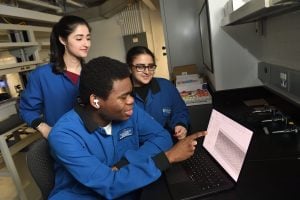
Photo by WIll Kirk.
“I think one of our conclusions for Design Day is going to be that we overshot and added way too much polycaprolactone to hold it together, which may take too long to degrade. So that’s one of the iterations that we’re going to suggest for next year is definitely pulling back on that,” said Kanuga.
Yacoub and Kanuga are seniors gearing up to graduate. Kanuga is headed to a job at the pharmaceutical and biotechnology corporation Johnson & Johnson. Yacoub is pursuing an MD/PhD program in bioengineering at the University of Florida. But they said they hope to pass this project along to next year’s seniors to continue finetuning the stent. For Yacoub, this project taught her how much can be accomplished with an engaged team.
“We could not have done it without our team. They were superstars. They did everything from unboxing the sutures all the way to making a computational model to simulate the degradation testing. They were also able to figure it out together, and I think a big part of that was being able to trust them to do what they needed to do. Their individual talents really helped the entire team come together. We made a fun little family.”
The group consists of Kanuga, Yacoub, Matthew Stryszak, Alicia Bai, Brianna Wu, Shrijani Buruganahalli, Advik Chandok, Addison Clift, Olaoluwa Odumade, and Leah Takamatsu. The ten students range from freshmen to seniors majoring in materials science, chemical and biomolecular engineering, and biophysics. The groups’ advisors on the project are Chris Schubert, an Assistant Professor in Surgery at Johns Hopkins School of Medicine, and materials science professor Tim Weihs.
Kanuga said this project also taught her that inspiration can come from anywhere and that sometimes, the path to a life-changing medical device starts with something as small and unlikely as a friendship bracelet.
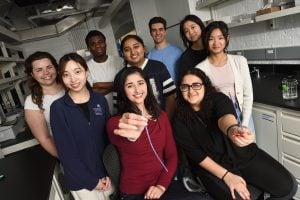
Photo by Will Kirk