To the naked eye, a piece of metal is just a piece of metal. But researchers like Tim Rupert, a professor of materials science and engineering and the Director of Hopkins Extreme Materials Institute (HEMI), are working to make metals stronger by changing how each tiny atom within a metal is packed together.
Rupert’s lab has spent a decade studying how to make materials more reliable and durable, including the use of nanocrystalline materials: metals engineered at the nanometer scale to be significantly stronger than they normally are.
Imagine the grains in a regular piece of metal sort of like a street paved with concrete slabs. In nanocrystalline metals, the grains are much smaller and more tightly packed, like a cobblestone street full of millions of pebbles packed together with mortar. This is what makes them strong. If you tried to damage the concrete street with a big shovel, whole sections might come up easily. But your shovel would catch on every single crack and pebble in the nanocrystalline cobblestone street.
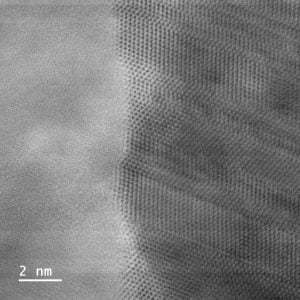
The standard, ordered grain boundary of two crystals in a piece of metal.
These nanocrystalline metals look the same as regular metals to the naked eye, but they are immensely stronger. They could be used to make safer cars, more earthquake-resistant buildings, or countless other uses.
Rupert says the catch with nanocrystalline materials at the moment is that they tend to be brittle. If you dropped a nanocrystalline metal like a dinner plate, it could shatter.
“We’ve been trying to make nanocrystalline materials tougher,” Rupert explains, adding that the materials are not widely used yet because they are prone to damage. “We want these metals to deform, bend, and absorb energy almost like a plastic, rather than shattering.”
Rupert’s group recently showed that the solution may lie along the edges of nanocrystalline materials. Here, at the materials’ so-called grain boundaries, individual metal particles meet when they solidify, like the cracks in pavement stones. Rupert says they began exploring an idea that may sound counterintuitive: deliberately making those boundaries amorphous, or more disordered, to improve the material’s toughness— so it can absorb damage and crumple or bend rather than breaking entirely.
“So, this opens the door for engineering these features, controlling what they look like, and improving your properties even more,” says Rupert.
Their findings, recently published in the journal Acta Materialia, show that it’s not only possible to make these materials stronger, but that they can be precisely controlled. The manuscript was led by joint first-authors Esther Hessong, of Sandia National Laboratories, and Zhengyu Zhang, a postdoctoral fellow in Rupert’s group at HEMI.
“From the outside, materials can look the same,” Rupert elaborates, “but we’re engineering the internal structure with really fine control – on the nanometer scale, or even sub-nanometer scale – to end up getting properties that are so much better than classical metals.”
Rupert says that, in the future, this could mean metals that are 10 to 25 times stronger than what we use today – lighter, safer cars; more efficient aircraft; or — one of Rupert’s main focuses —metals capable of better withstanding the radiation inside a nuclear reactor. Conventional metals used in nuclear reactors accumulate defects and degrade quickly.
Rupert and his team conducted the research with a mix of physical experimentation and computation.
They fabricated the materials using a process called powder metallurgy — creating metals by heating and compacting metal powder — and then examined the grain boundaries under a high-resolution transmission electron microscope. To understand the disordered structures on an atomic scale, the team had to develop new machine learning models capable of simulating these materials for the first time.
Rupert says the results of this research is a proof of concept. They now have a better understanding of what is happening inside the metal, how specifically to control and tweak the structure, and how to tune the local structure and chemistry of the grain boundaries with control than before.
Rupert says once they tracked the changes they were making more accurately using their computational models, he was surprised by how easy they were to engineer. It just took more knowledge of how grain boundaries were formed on the nanometer scale.
“So, I think it’s easier to access these amorphous features and easier to manipulate their structure than I thought going in,” Rupert says.
The work, funded by the Department of Energy, is still ongoing. Rupert says that the next frontier will be finetuning the amorphous regions of these metals to influence how they ultimately behave under stress. With the work from Rupert’s team, these “next generation” materials are becoming a reality.