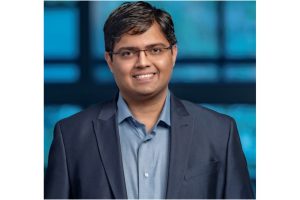
Join us in Maryland Hall room 110 at 3pm for a seminar from Deep Jariwala, Associate Professor and the Peter & Susanne Armstrong Distinguished Scholar in the Electrical and Systems Engineering as well as Materials Science and Engineering at the University of Pennsylvania (UPenn). His seminar is titled “III-Nitride Ferroelectrics for Low-Power and Extreme Environment Computing” and will take place on October 1.
Abstract: III-Nitride Ferroelectrics for Low-Power and Extreme Environment Computing
Since the demise of Dennard scaling, modern computer has largely relied on architectural innovations such as multi-core processors and GPUs vs CPUs to address the evolving needs of computing paradigm. This above problem has been exacerbated since computing has largely evolved from arithmetic centric to data centric in the age of billions of internet-connected devices and artificial intelligence. Thus, dense and reliable data storage combined with fast and high band-width access in novel memory devices has become the frontier for research in modern computing hardware. In this regard there have been several advancements across a variety of technologies in the past three decades. Ferroelectric materials and devices are among the forefront of these technologies due to their low-power and fast switching abilities but suffer from integration challenges. Simultaneously, developing data-heavy computing architectures in extreme environments is a growing need and a frontier challenge since silicon carbide (SiC) which is the leading logic technology for elevated temperature environments is limited by computing power and lack of memory devices that can operate at elevated temperatures.
Therefore, in this talk, I will try to make the case of how novel III-nitride materials might present interesting avenues to overcome some of the above limitations being faced by both Silicon and Silicon Carbide (SiC) hardware. I will start by presenting our ongoing and recent work on integration of 2D chalcogenide semiconductors emerging wurtzite structure ferroelectric nitride materials namely aluminium scandium nitride (AlScN). First, I will present on Ferroelectric Field Effect Transistors (FE-FETs) made from 2D materials when integrated with AlScN and make the case for 2D semiconductors in this application. I will then show our most recent results on scaling 2D/AlScN FE-FETs, achieving ultra-high carrier and current densities in ferroelectrically gated MoS and also demonstrate negative-capacitance FETs by engineering the AlScN/dielectric/2D interface.
Then, I will switch gears to introduce the ferroelectric diode (FeD) memory device and demonstrate multi-bit operation as well as compute in memory (CIM) using FeD devices made from AlScN. Finally, I will demonstrate why AlScN FeDs are uniquely suited as a high temperature non-volatile memory demonstrating stable operation up to 600 C and how AlScN can be integrated onto SiC for stable data retention in ferroelectric capacitors upto 1000 C I will end by providing a broad outlook on both AI computing hardware as well as high-temperature computing.
Bio: Deep Jariwala
Deep Jariwala is an Associate Professor and the Peter & Susanne Armstrong Distinguished Scholar in the Electrical and Systems Engineering as well as Materials Science and Engineering at the University of Pennsylvania (Penn). Deep completed his undergraduate degree in Metallurgical Engineering from the Indian Institute of Technology in Varanasi and his Ph.D. in Materials Science and Engineering at Northwestern University. Deep was a Resnick Prize Postdoctoral Fellow at Caltech before joining Penn to start his own research group. His research interests broadly lie at the intersection of new materials, surface science and solid-state devices for computing, opto-electronics and energy harvesting applications in addition to the development of correlated and functional imaging techniques. Deep’s research has been widely recognized with several awards from professional societies, funding bodies, industries as well as private foundations, the most notable ones being the Optica Adolph Lomb Medal, the Bell Labs Prize, the AVS Peter Mark Memorial Award, IEEE Photonics Society Young Investigator Award, IEEE Nanotechnology Council Young Investigator Award, IUPAP Early Career Scientist Prize in Semiconductors, the SPIE Early career achievement award and the Alfred P. Sloan Fellowship. He has published over 150 journal papers with more than 22000 citations and holds several patents. He serves as the Associate Editor for Nano Letters (ACS) and has been appointed as a Distinguished Lecturer for the IEEE Nanotechnology Council for 2025.