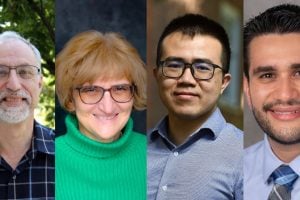
Four materials science professors were recently awarded funding through the Johns Hopkins Office of the Vice Provost for Research. OVPR offers two separate awards — the Catalyst Award and the Discovery Award — to support research by Hopkins faculty. Together, they comprise a nine-year, $45 million investment in the “creativity and collaborative spirit of the Johns Hopkins faculty.”
Assistant materials science professors Dingchang Lin and Corey Oses were selected as recipients of the 2026 Catalyst Award. The award is for early career faculty embarking on promising research or creative endeavors. Oses’ research focuses on developing databases, machine learning, and artificial intelligence frameworks to aid with the discovery of materials for clean and renewable energy. Lin, who is also a core researcher at the Institute for NanoBioTechnology, works at the intersection of materials, neurology, and biological systems. His research focuses on engineering proteins and devices that function in living organisms and address technological gaps in cell biology, neuroscience, and materials science. The award grants both Lin and Oses $100,000 towards their research as well as mentoring opportunities.
Materials science professors Howard Katz and Kalina Hristova were recipients of OVPR’s 2026 Discovery Awards. The Discovery Award recognizes “cross divisional teams, comprised of faculty and/or non-faculty members from at least two schools or affiliates of the university, who are poised to arrive at important discoveries.” Hristova researches the structure and assembly of biological membranes and how they inform cell signaling and drug delivery. The award will help fund her project entitled “Signaling Bias Induced by Oncogenic EGFR Mutations” with School of Medicine professor Chuan-Hsiang Huang.
Katz is a pioneer in organic electronics and photonics, the science of generating, controlling, and manipulating light. His research combines organic chemistry with the engineering of electronic devices. Katz received the award for his collaborative project with Hopkins Medicine researchers entitled “Non-Ammonium Polycations for Central Nervous System Gene Delivery to Treat Glioma.” Hristova and Katz’s awards both include $150,000 grants for their respective projects.