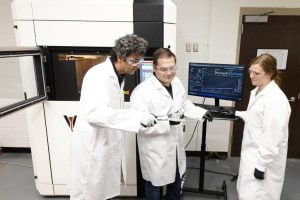
A new wire-fed metal extrusion 3D printing capability at Johns Hopkins University is expanding MSEE’s ability to rapidly prototype and evaluate architected metal structures for extreme environment research. Enabled through congressional funding, the ValCUN Minerva liquid metal extrusion system is the first of its kind deployed in a U.S. academic research laboratory, providing an energy-efficient and compact platform for manufacturing aluminum alloy structures of relevance to the mission of the Materials Science in Extreme Environments University Research Alliance (MSEE URA).
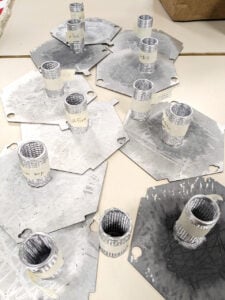
As-printed AA4043 structures shown still attached to the build platform; they can be released easily with light hand pressure.
Unlike many metal additive manufacturing systems that require industrial-scale infrastructure, the Minerva system operates on a 110 V power outlet and is sized to pass through a conventional doorway. This dramatically lowers the barrier to deployment in diverse manufacturing and research environments, opening possibilities for flexible, distributed manufacturing workflows. The extrusion process feeds metallic wire into a heated chamber, producing a continuous stream of molten metal that is precisely deposited along a programmed toolpath. The material solidifies rapidly upon deposition to form near-net shape components, or parts that are close enough to the desired final dimensions that post-processing isn’t necessary.
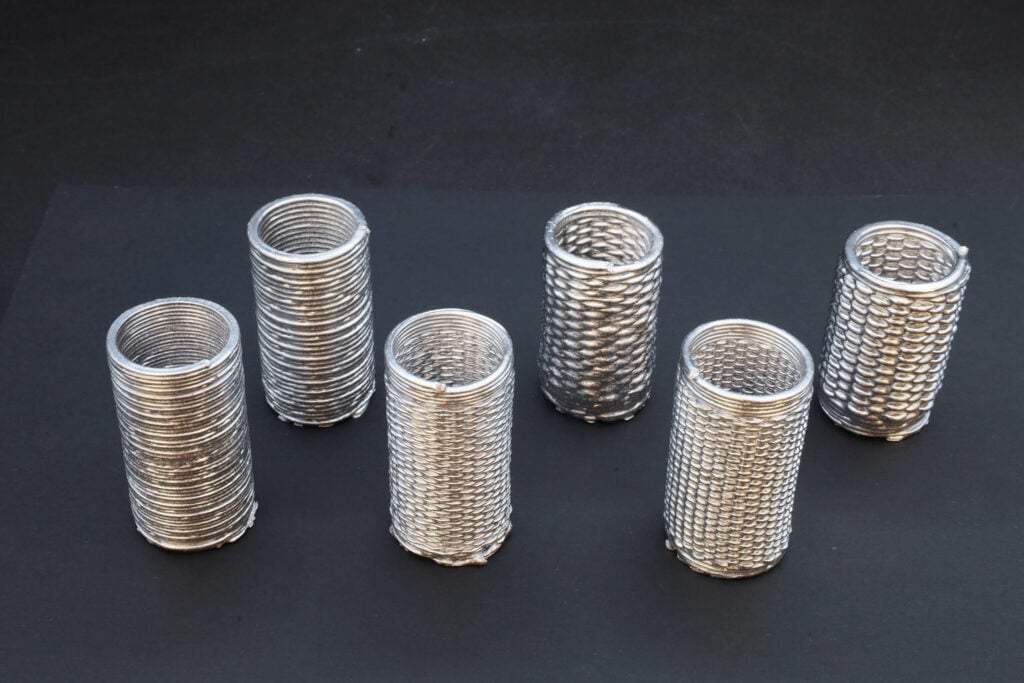
20-mm-diameter cylinders printed in AA4043 with varied surface profiles for quasi-static and high-impact testing. The profiles are designed to introduce stress concentrations and to control crack initiation and failure locations. By selecting specific architectures, scientists can create materials that break apart in predictable ways.
This capability enables the fabrication of thin-walled and lattice architectures in aluminum alloys with high geometric complexity. Of particular interest to the MSEE community is the ability to generate structural forms at multiple length scales, supporting both fundamental materials research and the design of application-oriented architectures. While current efforts focus on aluminum alloys, future research aims to expand the process window to magnesium-bearing and fully magnesium alloys, introducing pathways for printing lightweight and potentially reactive systems of interest for extreme condition studies. In parallel with the deployment of the Minerva system, Jochen Mueller’s Laboratory for Additive Manufacturing + Architected Materials is expanding and developing a custom in-house liquid metal extrusion platform to explore new alloy systems and deposition strategies, contributing to long-term innovation in metal additive processes.
Realizing the full potential of this technology requires coordinated characterization and diagnostic efforts across the MSEE URA. At Johns Hopkins University, collaborations with Tim Weihs of Research Area 2 are examining the microstructural evolution and reactivity of extruded metals, while Mark Foster and his colleagues in the CCRI contribute in situ thermal and optical diagnostics to monitor extrusion dynamics and defect formation. In collaboration with Nick Glumac at the University of Illinois Urbana-Champaign, future studies will explore combustion-relevant behavior and material response under energetic conditions, linking manufacturing pathways to performance in extreme environments and furthering the work being done in Research Area 3. The system is available as a shared MSEE facility, supporting cross-institution collaboration and workforce development.
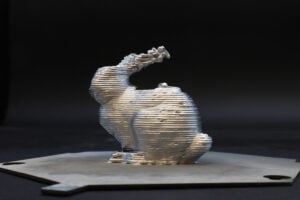
A 3D-printed “Stanford Bunny” demonstrating the ability to fabricate thin-walled structures with overhangs up to 5 mm in length without sacrificial support material.
Ongoing and upcoming work includes simulation-informed design workflows; expanded alloy libraries; and the creation of functionally tailored metallic architectures for structural, thermal, and reactive applications. By integrating manufacturing, diagnostics, and extreme environment testing, this new capability strengthens MSEE’s mission to accelerate materials innovation under defense-relevant conditions.
This article originally appeared on the Materials Science in Extreme Environments University Research Alliance website.