Create
Design Project Gallery
Finding the Fairest Voting System
- Program: Applied Mathematics and Statistics
- Course: Other
- Year: 2026
Project Description:
This work builds upon the 2020 work of Dougherty and Heckelman by determining the frequency that 13 voting systems violate Arrow’s social choice criteria with up to six alternatives. These results determine which of the 13 voting systems is the fairest based on their probabilistic likelihood of violating Arrow’s social choice criteria. The voting systems considered are Plurality, Borda, Dowdall, Top Two, Hare, Coombs, Baldwin, Copeland, Anti-Plurality, Nanson, Ranked Pairs, Pairwise Majority, and Minimax. Elections with up to 10,000 voters and between three and six alternatives are simulated using both Impartial Culture and Impartial Anonymous Culture. These simulations show that Pairwise Majority is the least likely to jointly violate Arrow’s criteria. As the number of alternatives increases, the joint-violation frequencies increase for each voting method. For all systems except Pairwise Majority, the joint-violation frequencies in elections with at least 30 voters and four alternatives are greater than 98%.
Project Photo:
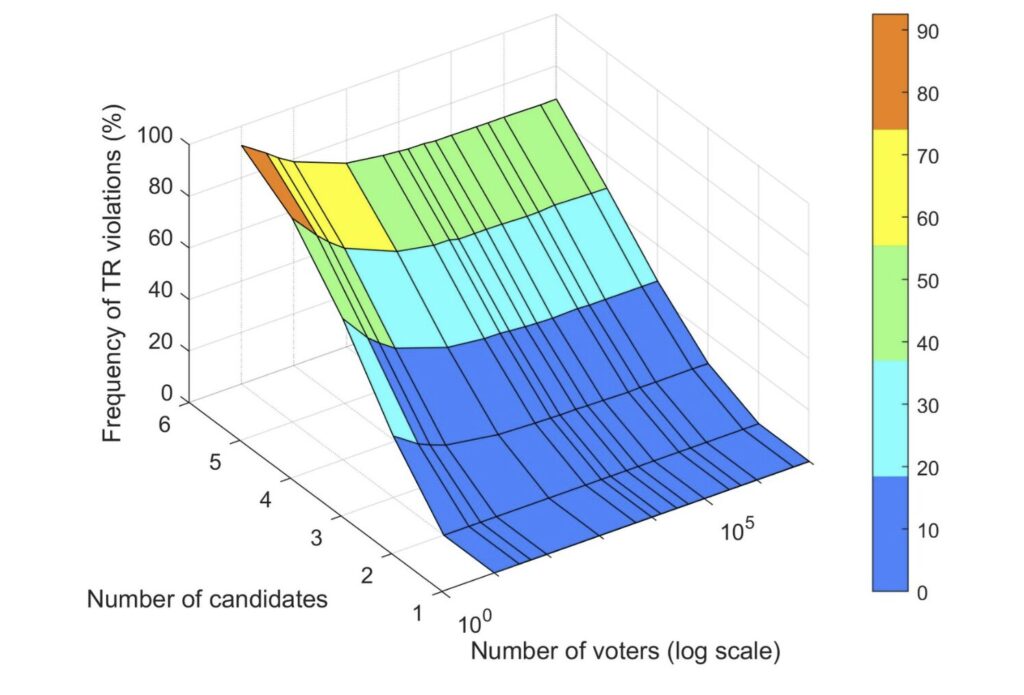
Violation frequency graph