
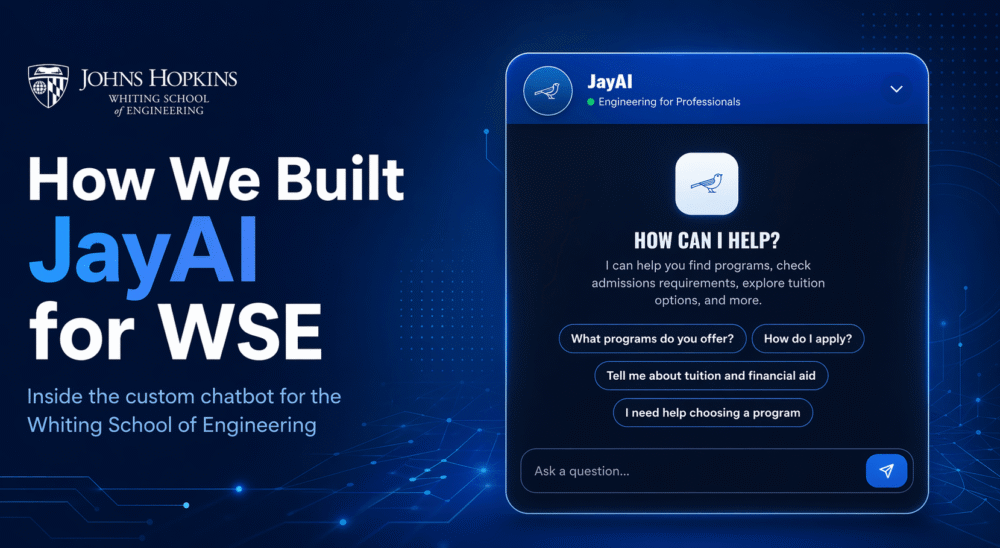
CMTS launched JayAI for Johns Hopkins Engineering in early April. JayAI is a new AI assistant that helps visitors find answers faster and navigate EP information more easily.
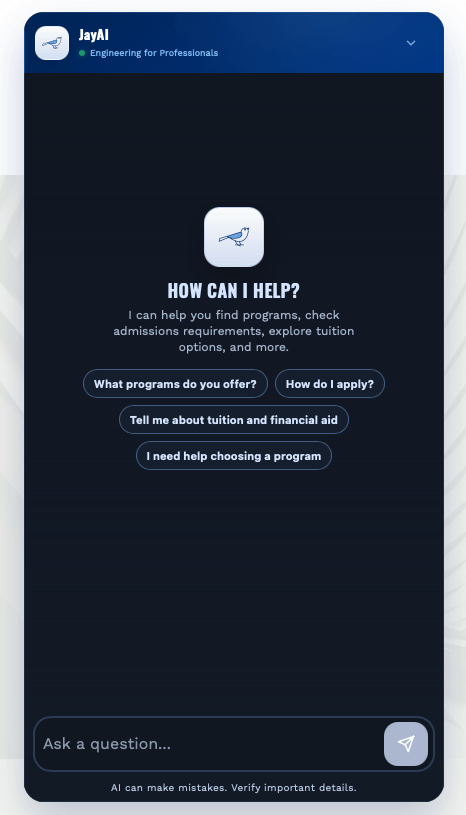
JayAI is a new front door for EP information, built to connect people with trusted answers more quickly.
Why JayAI Matters
Prospective and current students come to the website with practical questions about programs, admissions, cost, courses, and deadlines. The answers often already exist, but they are spread across many different pages and systems. JayAI helps people get information without having to know exactly where the source of the answer lives.
For EP, that means better self-service for students, fewer repetitive questions for staff, and better insight into what users are actually trying to understand.
JayAI Architecture
A practical higher education AI assistant that combines a website chat widget, verified EP data, retrieval, rule-based policy logic, model reasoning, and observability.
The Architecture at a High Level
At a high level, JayAI has a few core parts. The widget lives on the EP website so visitors can ask questions without leaving the page. Behind the scenes, a Cloudflare Worker handles routing and session logic, structured data in D1 supports reliable answers for known questions, and AI Search helps retrieve relevant content from the EP website.
When a question calls for comparison, explanation, or guidance, the AI model helps synthesize an answer, but it is only one part of the system. That balance is what keeps the experience useful without relying exclusively on the model.
The Most Important Design Choice
One of the most important decisions we made was not treating every question the same way. Some questions need a rule-based answer. Some are better answered through structured data. Others call for retrieval from EP website content. And some benefit from AI synthesis, especially when a user is comparing options or asking for guidance.
How We Built It
1. We started with real user questions
We did not begin with model prompts. We started with the practical questions students, faculty, and staff already ask every day. Those questions shaped the data model, the routing logic, the interface, and the tests.
2. We built a trusted data layer
We brought together structured data so JayAI could answer many common questions consistently and accurately. That includes program information, course and section data, instructor profiles, event data, policy-style fast facts, and teaching history.
3. We used AI where AI is strongest
AI becomes most useful when a question is nuanced, such as helping someone compare programs or think through which option best fits their background and goals. In those cases, the AI model helps with synthesis and explanation, but it still works with EP-specific tools and source data.
4. We kept high-risk answers controlled
For questions involving tuition, admissions requirements, MFA/JHED support, academic calendar dates, and similar policy areas, we used rule-based or source-grounded paths.
That approach reduces the chance of a polished but incorrect answer.
5. We designed for trust
JayAI shows source links when answers rely on EP pages, course pages, program pages, or other official sources.
The goal is not to hide the source. The goal is to help users get to the right source faster.
6. We added observability from the beginning
We log lightweight chat-start summaries and model activity so we can see what users are asking, which pages they ask from, where the assistant is helping, and where it still needs improvement. That is how we move from assumptions to evidence.
What We Learned That Others Can Use
If you want to build something similar, a practical pattern is:
- Start with real user questions.
- Separate the kinds of answers you need.
- Build a trusted data layer.
- Use retrieval for official content.
- Measure what users ask and where answers fall short.
- Launch small and improve from real usage.
Lessons Learned
JayAI reinforced a few things for us: good AI assistants need product thinking, not just prompt design. Grounded answers matter more than clever ones. Clear rules are often the safest choice, and strong logging helps improve the experience over time. The best approach is usually a hybrid one.
Final Thought
JayAI is a practical example of how higher education can use AI responsibly.
It gives users faster answers, provides staff better insight into demand, and affords the institution a scalable way to make complex information easier to navigate.
 Stay Connected
 OneHop
 Facebook
 X
X Instagram
 YouTube
 LinkedIn
Recent Comments