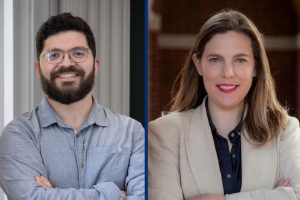
Three faculty members from Johns Hopkins University have been named 2026 Sloan Research Fellows by the Alfred P. Sloan Foundation. These two-year, $75,000 fellowships are awarded to early-career scientists in the U.S. and Canada who show strong potential to be leaders in their fields. Mateo Díaz, Yayuan Liu, and Soledad Villar, assistant professors at the university’s Whiting School of Engineering, are among 126 scholars recognized as fellows this year.
With the addition of Díaz, Liu, and Villar, JHU has now had 92 Sloan Research Fellows since the award’s creation in 1955. Candidates must be tenure-track, though untenured, faculty members in the fields of chemistry, computer science, Earth system science, economics, mathematics, neuroscience, or physics. The fellowship is extremely prestigious and competitive, with more than 1,000 nominations each year.
About the researchers
Mateo Díaz, an assistant professor in the Department of Applied Mathematics and Statistics and a member of the Mathematical Institute for Data Science and Data Science and AI Institute, studies the interaction between optimization, statistics, and geometry with a focus on designing and analyzing practical, large-scale algorithms for applications across data science, machine learning, operations research, and signal processing.
His interest in optimization stems from its universal relevance to science and engineering. “Optimization is critical for training machine learning models, planning complex logistics, and controlling autonomous systems like robots and drones,” Díaz said. “However, the inherent nonconvexity and nonsmoothness of these applications, combined with their scale, make them difficult to tackle using traditional methods. My goal is to develop efficient algorithms capable of navigating these structural difficulties at contemporary scales.”
Díaz said he is deeply honored to be recognized by the Sloan Foundation. “Being named a Sloan Fellow feels surreal and humbling given the historic weight and legacy of this award,” he said. “I am incredibly grateful for this fellowship, which will allow my group and me to continue pursuing the fundamental questions we are most passionate about.”
Yayuan Liu, assistant professor of chemical and biomolecular engineering with a secondary appointment in materials science, works at the interface of chemical engineering, materials science, and electrochemistry to accelerate the realization of energy and environmental sustainability. The Liu research group engineers materials and electrochemical processes, using advanced characterization to connect microscopic phenomena with macroscopic performance. Its work centers on redox-active carbon capture and electrosynthesis, precision electrochemical interfaces for separations, and high-resolution imaging of electrochemical processes.
“I’m honored to be selected as a 2026 Sloan Research Fellow,” Liu said. “This fellowship is incredibly meaningful to me, as it recognizes not only the work our group has accomplished so far but also the broader vision of advancing electrochemical technologies for carbon capture and critical materials recovery. I’m especially grateful to my students and collaborators, whose creativity and dedication make this research possible.”
With this recognition, Liu will advance ambitious research at the forefront of sustainable electrochemical engineering.
“The Sloan Fellowship will provide valuable flexibility to pursue high-risk, high-reward ideas that aim to make electrochemical processes more scalable, energy-efficient, and impactful for addressing climate and resource challenges,” she said.
Soledad Villar is an assistant professor of applied mathematics and statistics at the Mathematical Institute for Data Science at Johns Hopkins University, whose research sits at the intersection of mathematical data science, representation learning, geometric deep learning, and equivariant machine learning. Her work focuses on using tools from algebra and geometry to design machine learning models with desirable mathematical properties, such as incorporating symmetry and physics-inspired constraints directly into their structure.
While her research is rooted in mathematical theory, Villar says the resulting principles play an increasingly important role in shaping how machine learning models are designed and deployed across a wide range of scientific applications.
“AI is built and communicated in mathematical language, and even though it may seem like a black box at times, mathematics can be used to understand why and how it works, and how we can improve it,” Villar said. “Incorporating mathematical principles into the design of AI models is a natural way to make them more effective and reliable for scientific discovery.”
Her lab’s work explores how models can generalize across varying data sizes or computational scales, an area of growing interest as researchers seek more efficient and adaptable machine learning systems. Villar is particularly excited about emerging mathematical connections between any-dimensional machine learning and hyperparameter transfer, two complementary approaches that aim to improve how models are trained and applied.
“Any-dimensional machine learning relies on the observation that many machine learning models are defined on a fixed set of parameters but can be evaluated on inputs of any size or dimension,” she said. “Hyperparameter transfer takes a complementary perspective by identifying how optimization strategies developed for smaller models can be applied to larger ones, allowing us to design more efficient and scalable systems.”
Villar credited her students, postdoctoral fellows, and collaborators as central contributors to the work recognized by the Sloan Research Fellowship. “My students, postdocs, and collaborators are a fundamental part of my research program,” she said. “Honestly, I wouldn’t have this award if it weren’t for them.”
This excerpt was taken from the Hub. You can read the full story here.