Create
Design Project Gallery
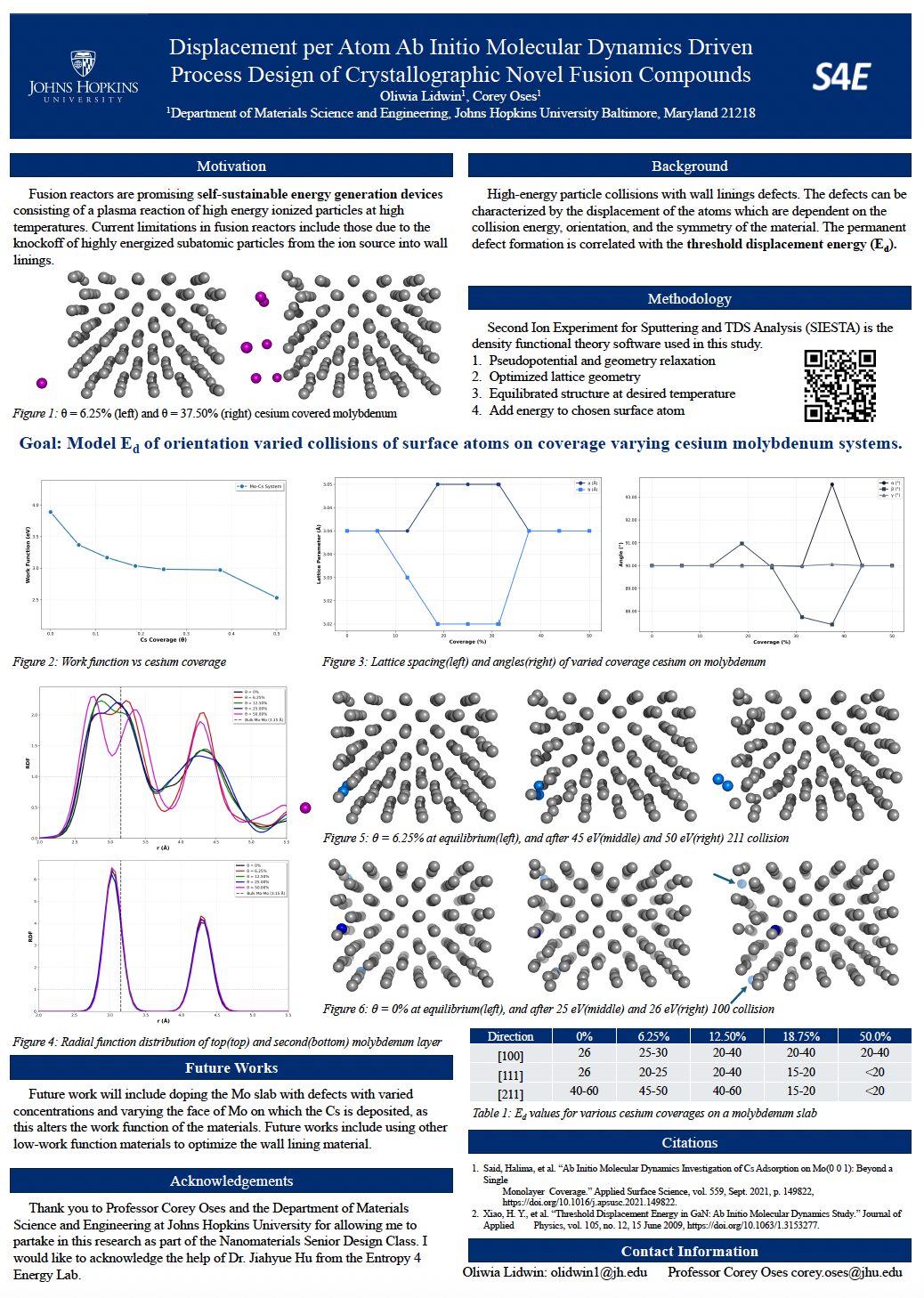
Displacement per Atom Ab Initio Molecular Dynamics Driven Process Design of Crystallographic Novel Fusion Compounds
- Program: Materials Science and Engineering
- Course: EN.510.441 Nanomaterials senior Design II
- Year: 2026
Project Description:
Fusion reactors are next generation self-sustainable energy generation systems. They are currently limited by their wall linings, which experience high-energy collisions from subatomic particles from the plasma. The collision damage is studied to find permanent defects and the energy threshold which the material can withstand before the formation of the defect. Varied cesium monolayer coverages on bulk molybdenum were studied using density functional theory and molecular dynamics. At higher cesium coverages, the molybdenum layer at the interface with cesium experienced surface stress. All other molybdenum layers experienced the expected lattice spacing. In the vacuum-cesium-molybdenum system, a vacuum interfacial surface atom was accelerated into the molybdenum in crystallographic planes chosen based on body centered cubic molybdenum high-symmetry directions. One studied direction had higher threshold values for lower coverages, most likely due to the smaller incident angle and longer interaction time with the surface.
Project Photo:
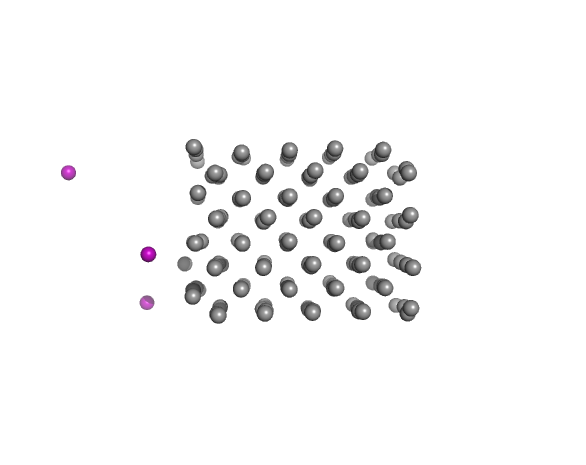
18.75% coverage cesium on molybdenum following 20eV collision