

Create
Design Project Gallery
Magfit Dynamic: A Magnetically Adjustable Sling for Urinary Incontinence
- Program: Center for Leadership Education
- Course: EN.660.346 Multidisciplinary Engineering Design 2
- Year: 2026
Project Description:
24-45% of women over 30 in the US experience stress urinary incontinence. While surgical slings are widely used to support the urethra to prevent leakage, they are fixed after implantation and cannot be easily adjusted on a daily basis, and they may require surgery if there is urinary retention or persistent leakage due to tension loss.
To fill this gap, a sling with an integrated adjustable region was designed so that it can be tightened or loosened externally without the need for surgery nor a battery-powered implant. Specifically, an implanted magnetically actuated mechanism is used to enable non-invasive adjustment through an external magnetic controller. This allows the level of urethral support to be tailored over time and provides an option for increased support during daily activities that can trigger leakage and reduced tension during urination.
This approach aims to offer a more adaptable and patient-personalized alternative to existing sling treatments.
Project Photo:
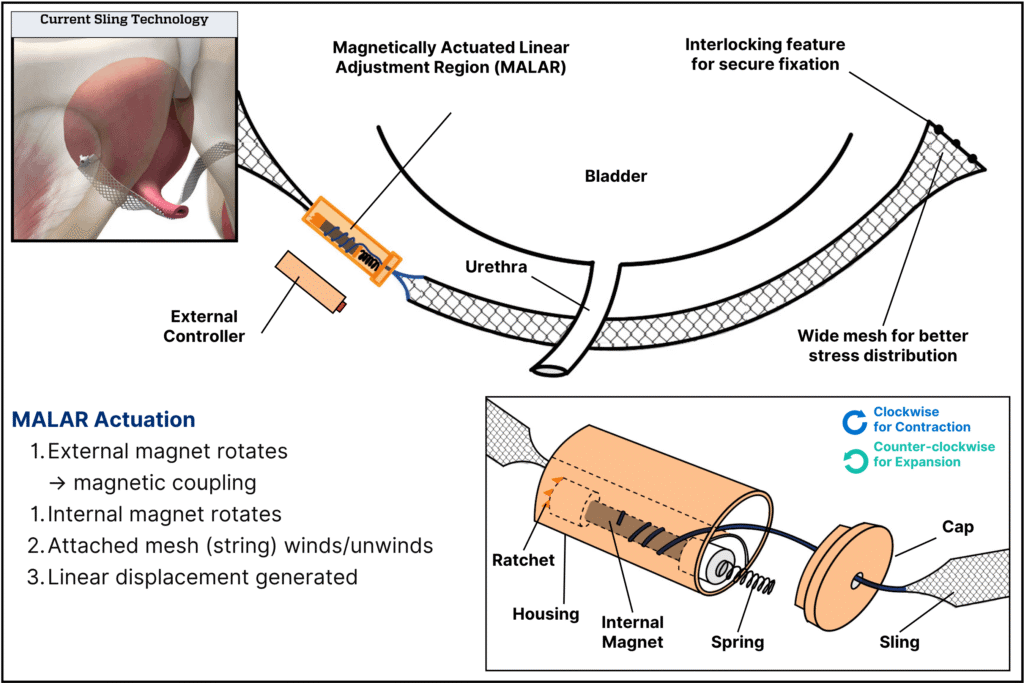
MagFit Dynamic: a mid-urethral sling with magnetically actuated linear adjustment region (MALAR). An external magnetic controller generates a magnetic field that induces rotation of an internal magnet, enabling controlled tightening or loosening of the sling. The design integrates wide mesh anchoring and interlocking features for stable fixation and stress distribution.
Project Poster
Open full size poster in new tab (PDF)
Project Poster Summary:
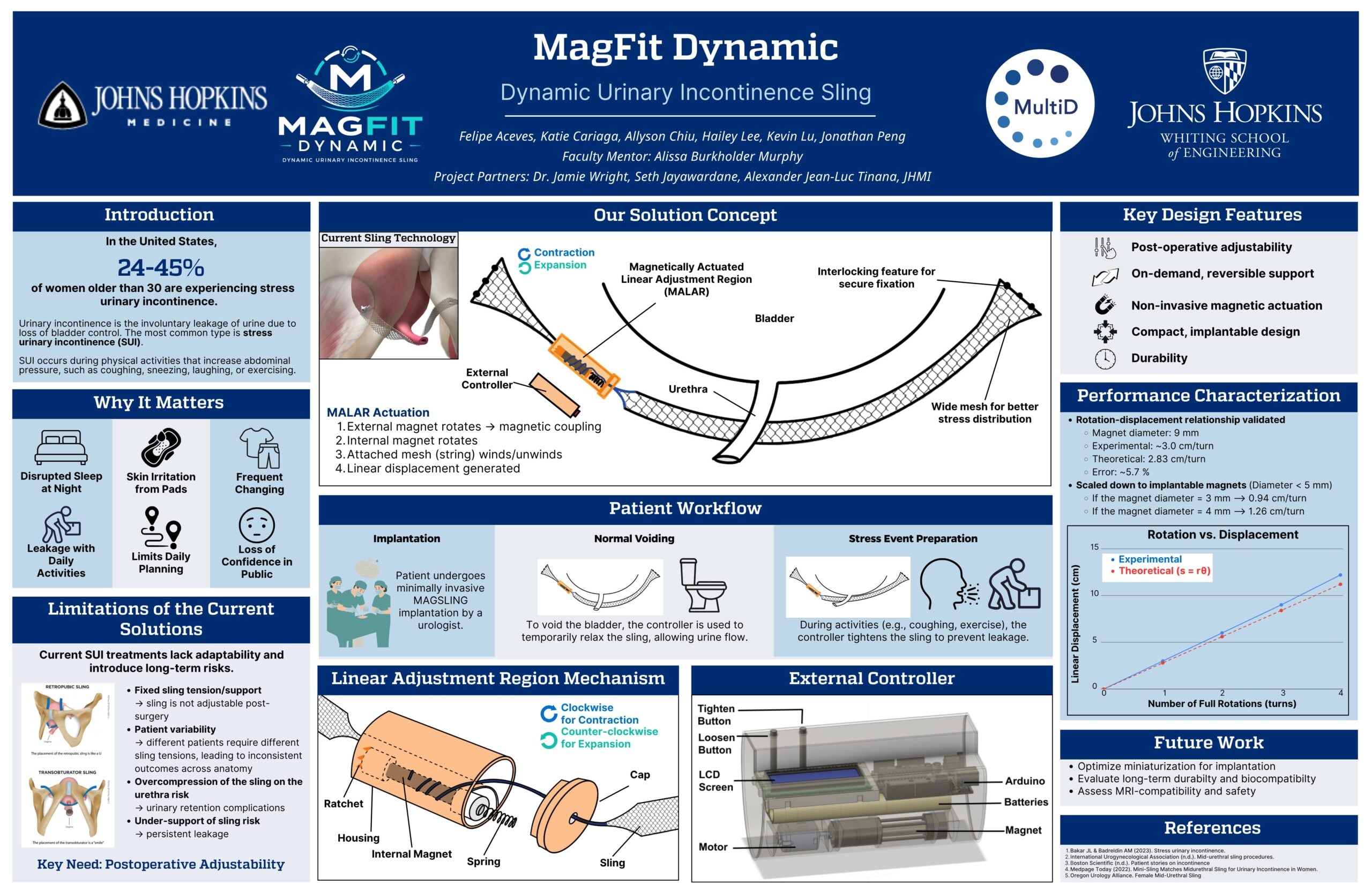
MagFit Dynamic is a magnetically adjustable mid-urethral sling designed to treat stress urinary incontinence by enabling dynamic control of sling tension. Unlike current slings, which are fixed after implantation, this system uses magnetic coupling to actuate an internal mechanism that tightens or loosens the sling on demand.
The design improves patient outcomes by allowing dynamic support during activities (e.g., coughing) and relaxation during normal voiding. Key features include a compact implantable adjustment region (MALAR), non-invasive external control, and enhanced anchoring through wide mesh and interlocking structures.
Experimental results validate the rotation-to-linear displacement mechanism and demonstrate predictable, scalable performance, supporting the feasibility of precise, mm-scale adjustments for clinical use.