

Create
Design Project Gallery
Phoenix Evac
- Program: Center for Leadership Education
- Course: EN.663.657 Innovation & Design 2
- Year: 2026
Project Description:
Phoenix Evac is a semi-autonomous drone designed to evacuate injured soldiers quickly from high-risk and hard-to-reach environments. In modern combat, 25–35% of deaths are considered preventable if casualties receive care within the “golden hour.” However, evacuation delays of 2–4 hours are common, and 40–60% of casualty locations are unreachable due to terrain, weather, or active threats.
Our system addresses this gap by enabling fast, terrain-independent evacuation with reduced risk for other medics. The drone carries a NATO-compatible stretcher inside an enclosed carriage pod and can be loaded by a nearby soldier using a simple pull-out mechanism. Built-in safety features, including secure locking, vibration isolation, and protective internal lining, ensure stable and safe transport.
By reducing evacuation time to under 60 minutes, Phoenix Evac improves survival outcomes in environments where existing evacuation systems cannot operate.
Project Photo:
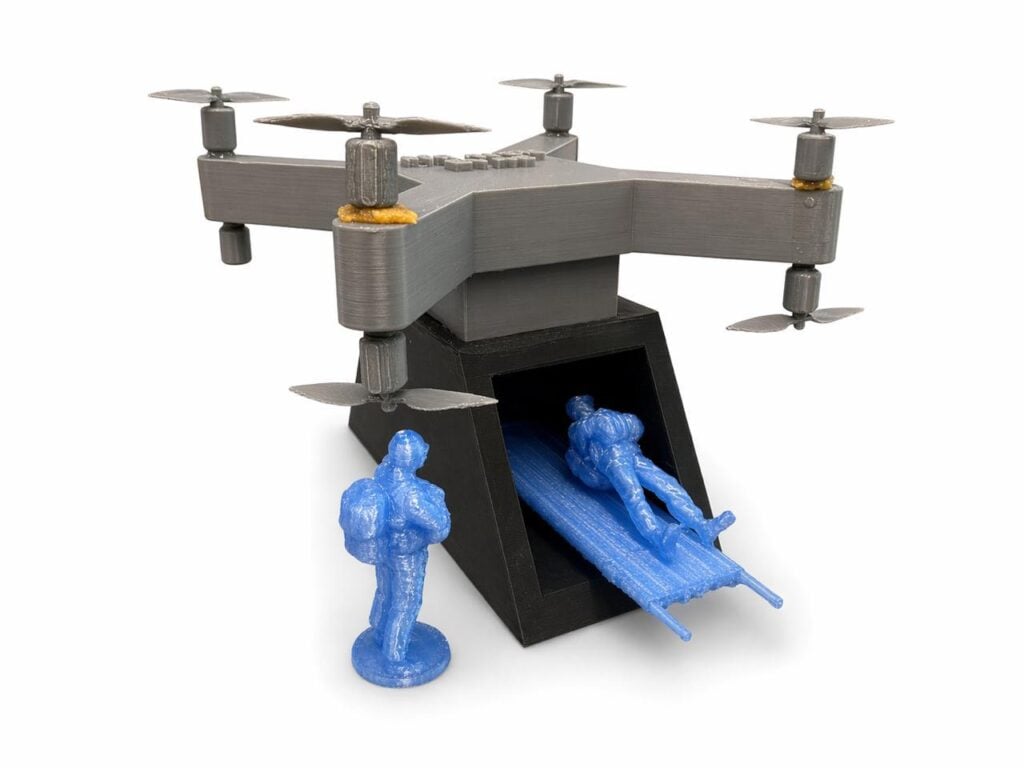
This mini 3D-printed prototype demonstrates the Phoenix Evac use case, where a casualty is loaded onto a stretcher through a pull-out tray into the drone’s carriage, showing a simple and rapid evacuation process designed for high-risk environments.
Project Poster
Open full size poster in new tab (PDF)
Project Poster Summary:
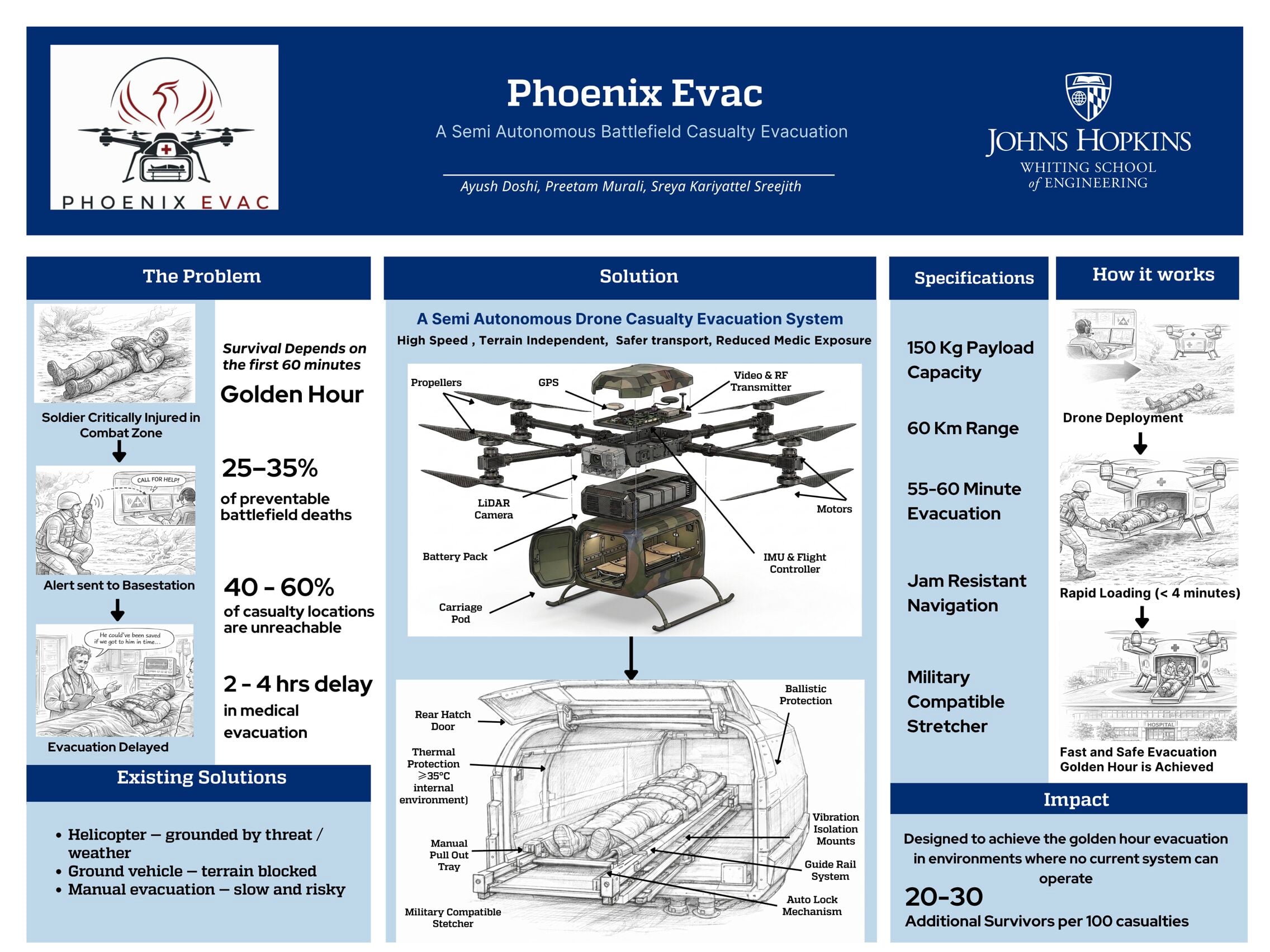
This poster presents Phoenix Evac, a semi-autonomous drone system designed for rapid casualty evacuation in high-risk environments. It highlights the problem of delayed evacuation in modern combat, where 2–4 hour delays are common and 25–35% of deaths are preventable if care is received within the golden hour.
The poster explains our solution, including the drone architecture, enclosed carriage system, and a simple single-soldier loading mechanism using a NATO-compatible stretcher. Key safety features such as secure locking, vibration isolation, and internal protection are also illustrated.
It visually walks through the full use case—from injury to evacuation—and summarizes the system’s impact, including reducing evacuation time to under 60 minutes. Overall, the poster demonstrates how Phoenix Evac enables faster, safer, and more reliable evacuation where current systems cannot operate.