Create
Design Project Gallery
Corrosion Dependence on Processing-induced Dislocations in Mg Alloys
- Program: Materials Science and Engineering
- Course: EN.510.439 Biomaterials Senior Design II
- Year: 2026
Project Description:
Magnesium alloys are becoming increasingly relevant as potential orthopedic implant materials, offering great biocompatibility and biodegradability. Mg-Al is one such commonly studied alloy with heightened strength and high tunability as well. It has strong potential to enter the market, even being FDA approved as temporary vessel scaffolds and bone screws. One critical downfall of these alloys is that it is difficult to balance the rate at which they corrode with the speed at which the body heals while still maintaining the necessary mechanical strength. To overcome this, these alloys undergo processing that induces numerous microstructural features, like precipitates, twins, and dislocation cells. In these alloys, precipitates have always played a great role in dictating corrosion rates, oftentimes overshadowing other microstructural features. This study aims to thus determine the dominance hierarchy of various microstructural features for the further design of biomedical grade implants.
Project Photo:
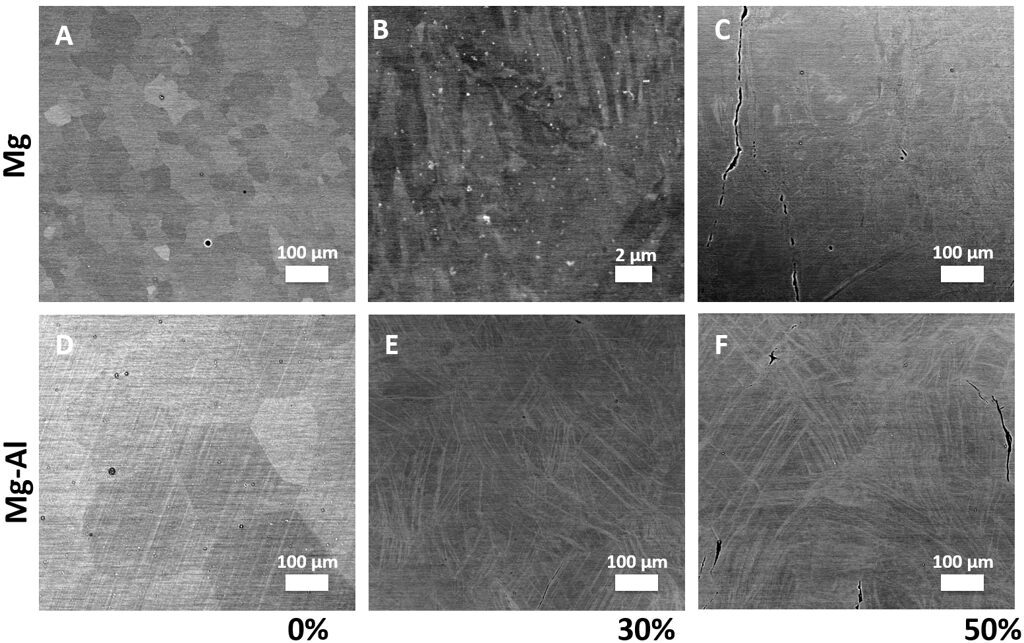
Microstructural Features of Mg and Mg-6Al