

Create
Design Project Gallery
Precision Care Psychiatry
- Program: Biomedical Engineering
- Course: EN.580.480 Precision Care Medicine
- Year: 2026
Project Description:
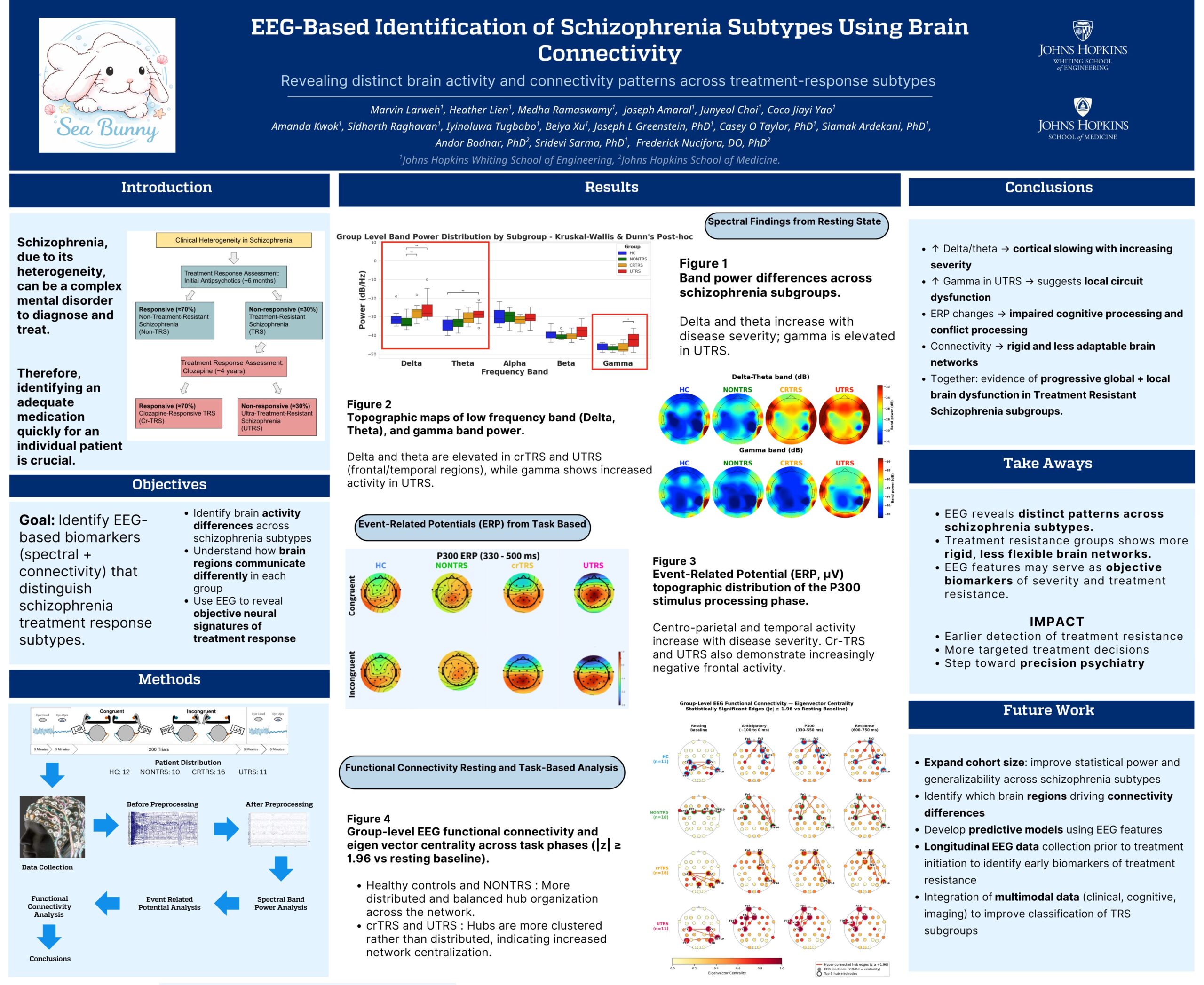
Our project presents an EEG based study of schizophrenia subtypes focusing on differences in treatment response. The work examines whether patterns in brain activity and functional connectivity can provide biomarkers for distinguishing clinically meaningful subgroups. To address this question, we analyze resting state spectral power, task related event related potentials, and network level connectivity across healthy controls and schizophrenia subtypes. The findings indicate that neural abnormalities become more pronounced with increasing illness severity. Lower functional activity shows a progressive increase across more severe groups, while abnormalities in higher functional activity may reflect disrupted local regional function in the most treatment resistant patients. Task based results further suggest deficits in cognitive control and information processing, and functional connectivity analyses indicate a shift toward rigid and centralized network organization. These results support the potential of EEG derived measures as biomarkers for subtype classification, early recognition of treatment resistance, and more individualized psychiatric care.
Project Photo:
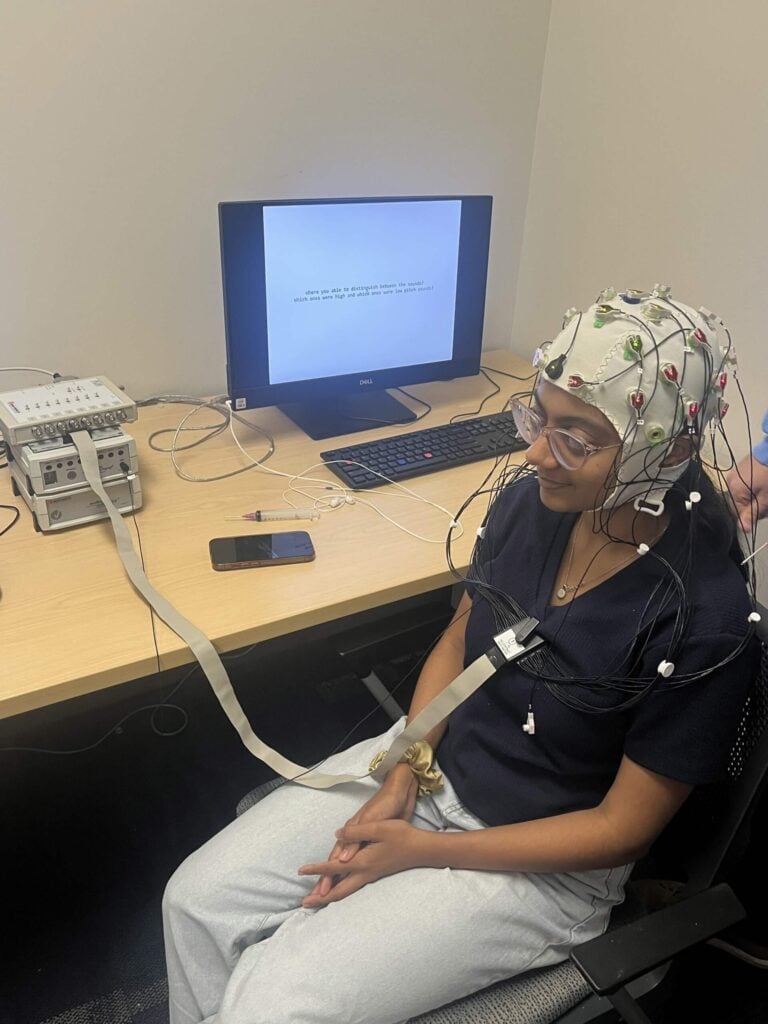
Team SeaBunny visited Dr.Andor Lukacs Bodnar’s Lab to understand the procedure of the experiment design. Medha’s EEG was recorded.
Project Poster
Open full size poster in new tab (PDF)
Project Poster Summary:
Our project presents an EEG based study of schizophrenia subtypes focusing on differences in treatment response. The work examines whether patterns in brain activity and functional connectivity can provide biomarkers for distinguishing clinically meaningful subgroups. To address this question, we analyze resting state spectral power, task related event related potentials, and network level connectivity across healthy controls and schizophrenia subtypes. The findings indicate that neural abnormalities become more pronounced with increasing illness severity. Lower functional activity shows a progressive increase across more severe groups, while abnormalities in higher functional activity may reflect disrupted local regional function in the most treatment resistant patients. Task based results further suggest deficits in cognitive control and information processing, and functional connectivity analyses indicate a shift toward rigid and centralized network organization. These results support the potential of EEG derived measures as biomarkers for subtype classification, early recognition of treatment resistance, and more individualized psychiatric care.