

Create
Design Project Gallery
STRIDE
- Program: Biomedical Engineering
- Course: EN.580.571 Honors Instrumentation
- Year: 2026
Project Description:
This project explores whether high-resolution plantar pressure data can reveal intrinsic gait patterns using a fully data-driven approach. Utilizing the Re-Kinesis system (~64×16 sensors, ~250 Hz), each time step is treated as a pressure image, enabling analysis without predefined biomechanical features such as center of pressure or symmetry indices.
Unsupervised learning methods (PCA and K-means) are applied directly to raw data to identify latent structure in gait. Data were collected under controlled conditions, including normal walking and induced asymmetries using split-belt treadmill speeds and ankle restriction, representing varying levels of impairment.
Preliminary results show that clustering can distinguish between normal, mild, and severe gait deviations based solely on pressure patterns. These findings suggest that high-resolution plantar data contains meaningful, underutilized information.
This work establishes a foundation for objective, scalable gait analysis systems capable of early detection, monitoring, and future rehabilitation applications.
Project Photo:
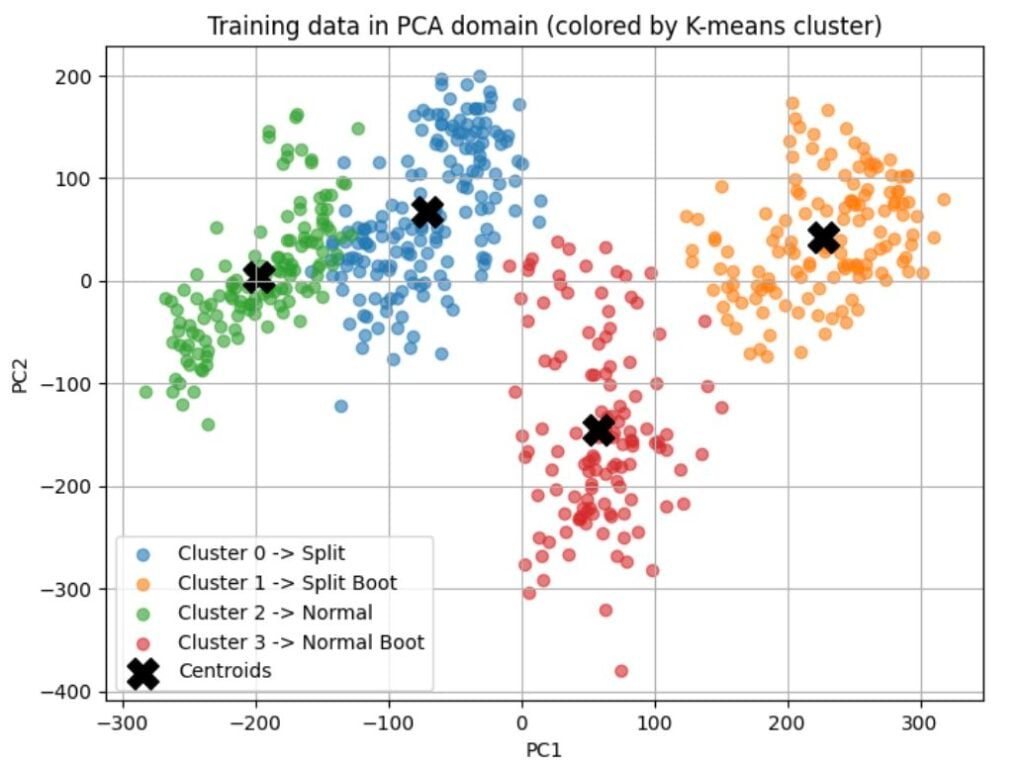
Unsupervised clustering of plantar pressure data reveals distinct gait patterns across normal and asymmetric conditions, showing that meaningful structure can be identified directly from high-resolution raw measurements.
Project Poster

Open full size poster in new tab (PDF)
Project Poster Summary:
This project explores how high-resolution plantar pressure data can be used to identify gait abnormalities using a fully data-driven approach. Instead of relying on predefined biomechanical metrics, we apply unsupervised learning techniques (PCA and K-means) directly to raw pressure data collected from wearable insoles.
By analyzing walking under normal and artificially induced asymmetric conditions, we show that distinct gait patterns naturally emerge without labeled data. The model is able to separate and group different gait states, including normal, mild, and severe asymmetry.
These findings demonstrate that meaningful structure exists within raw plantar pressure signals and can be leveraged for objective gait analysis.
This work lays the foundation for scalable tools that enable continuous monitoring, early detection of abnormalities, and data-driven rehabilitation in real-world settings.