

Create
Design Project Gallery
Retinal Biomarkers of Acute Stroke
- Program: Biomedical Engineering
- Course: EN.580.480 Precision Care Medicine
- Year: 2026
Project Description:
This project aims to address the critical need for accessible, early diagnostic tools for ischemic stroke, a leading cause of death and disability. Typically, developing artificial intelligence diagnostic models is hindered by a severe lack of clinical data due to privacy constraints. To overcome this, researchers utilized retinal imaging, which offers a non-invasive alternative to traditional diagnostic infrastructure.
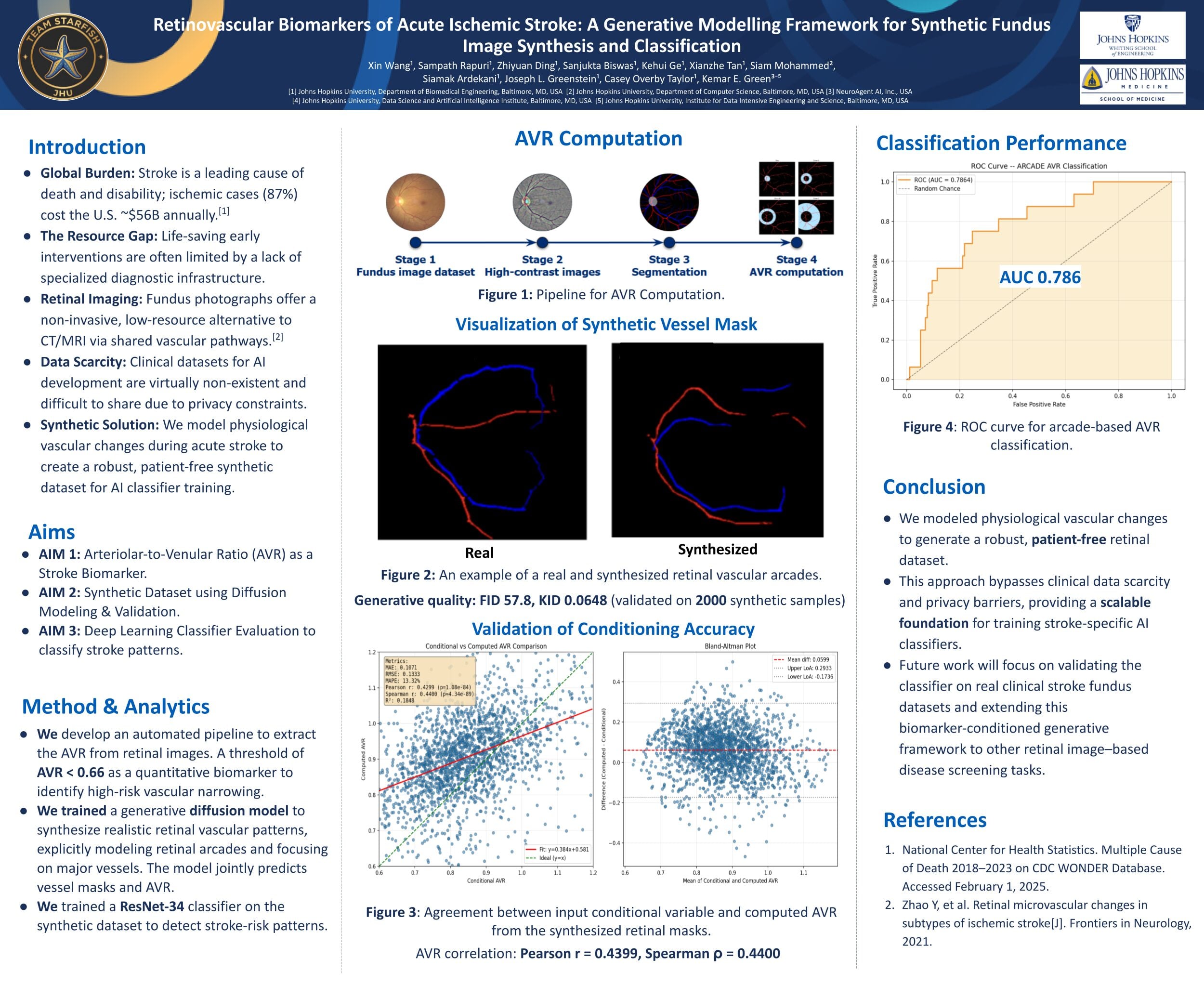
Instead of relying on real patient records, this team built a generative AI framework to create synthetic images of retinal blood vessels. By focusing on specific vascular changes associated with stroke risk, namely the Arteriolar-to-Venular Ratio (AVR), the model generates a robust, privacy-free dataset. This synthetic data was then successfully used to train a deep learning classifier capable of identifying stroke-risk patterns. Ultimately, this pipeline bypasses traditional data roadblocks, paving the way for scalable, low-resource stroke screening tools.
Project Photo:
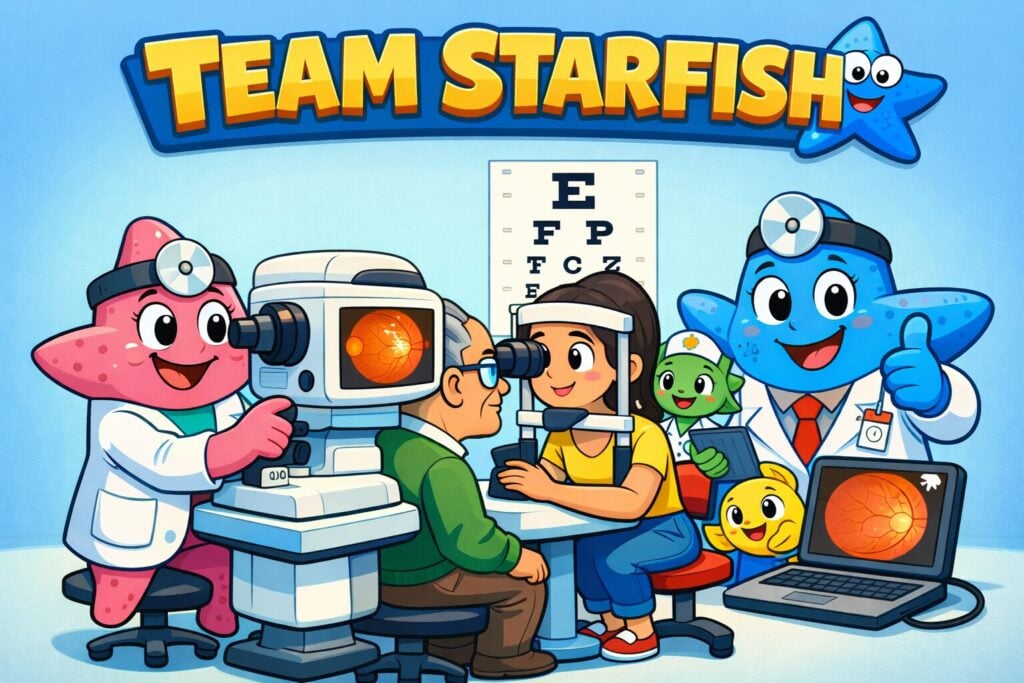
Team Starfish in action! This illustration represents our project’s focus on using non-invasive retinal imaging. Our AI models analyze fundus photographs, like the ones on screen, to identify critical vascular biomarkers for early stroke detection.
Project Poster
Open full size poster in new tab (PDF)
Project Poster Summary:
We designed a generative modeling framework for detecting acute ischemic stroke through retinal fundus images. Because clinical AI training data is scarce and restricted by patient privacy barriers, we utilized a generative diffusion model to create a synthetic, patient-free dataset of realistic retinal vascular patterns. Our study leverages the Arteriolar-to-Venular Ratio (AVR) as a diagnostic biomarker, defining an AVR under 0.66 as indicative of high-risk vascular narrowing. By training a ResNet-34 deep learning classifier on these synthetic images to detect stroke-risk patterns, the team achieved a classification Area Under the Curve (AUC) of 0.786. Ultimately, this innovative approach circumvents data limitations, providing a highly scalable foundation to train AI classifiers for early stroke screening.