

Create
Design Project Gallery
Developing Analytics for Precise Measurement of Hand Dysfunction in Stroke Survivors
- Program: Biomedical Engineering
- Course: EN.580.480 Precision Care Medicine
- Year: 2026
Project Description:
Stroke is a leading cause of long-term disability and often results in impaired hand function that limits independence. Current clinical assessments rely on subjective observation and coarse scoring, making it difficult to detect subtle deficits in coordination or track recovery over time.
This project investigates whether fine-grained fingertip force measurements can provide objective biomarkers of post-stroke motor impairment. Using SenseHand, a portable device that measures grip and load forces during grasp-and-lift tasks, we collected data from 13 stroke survivors across multiple sessions and task conditions.
We developed a machine learning pipeline to automatically identify valid trials and extract key features of motor coordination, such as force timing and grip–load relationships. Our results show that these quantitative metrics can distinguish impaired from unimpaired movement and capture changes over time.
This work demonstrates the potential of sensor-based analytics to enable objective, data-driven, and personalized stroke rehabilitation.
Project Photo:
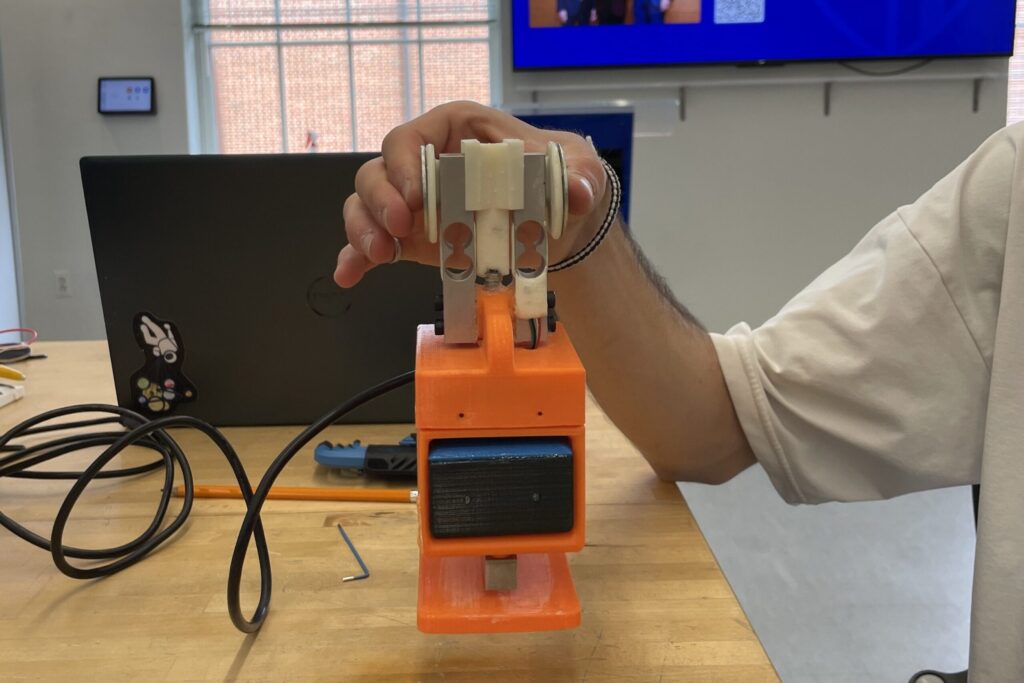
SenseHand is a portable, instrumented grip device designed to measure grip and lift forces in real time. With interchangeable textures and weights, it mimics everyday objects to assess hand function in both clinical and at-home settings.
Project Poster
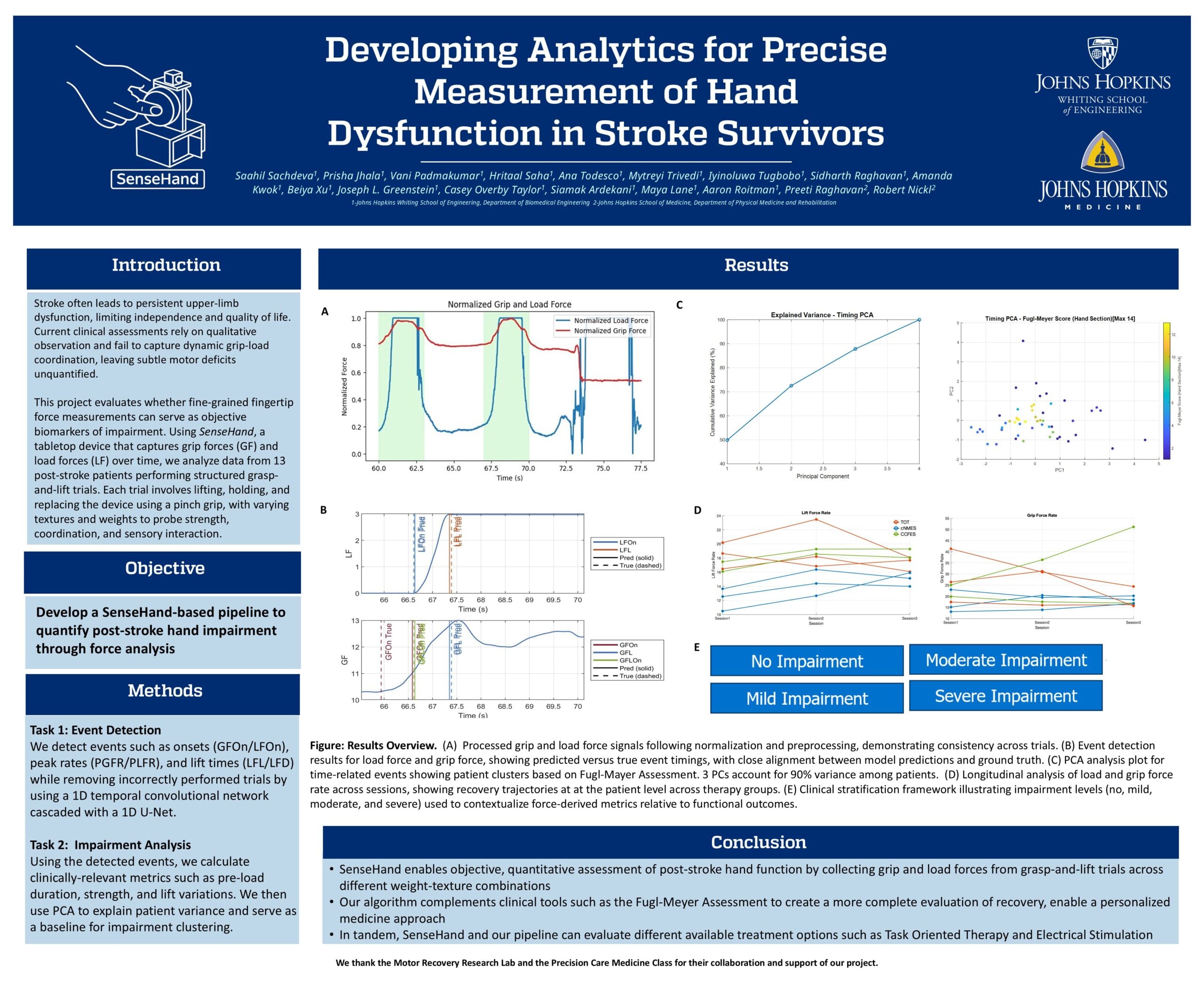
Open full size poster in new tab (PDF)
Project Poster Summary:
This project introduces a data-driven method to quantify hand dysfunction in stroke survivors using fingertip force measurements from the SenseHand device. Traditional clinical assessments, while valuable, often rely on qualitative observation and may miss subtle grip–load coordination deficits. To address this, we developed a pipeline that uses a temporal convolutional network to identify and filter out invalid trials. A U-Net model then detects clinically relevant force events with high temporal precision. We extract force- and time-based features from these signals and apply principal component analysis to identify key patterns of variability across patients. The relationship between these features and clinical impairment is assessed using linear mixed-effects models. This framework provides an objective, quantitative assessment of motor function and supports scalable monitoring and personalized rehabilitation for stroke recovery.