

Create
Design Project Gallery
Precision ECMO: Survival Prediction in Postcardiotomy VA-ECMO Patients
- Program: Biomedical Engineering
- Course: EN.580.480 Precision Care Medicine
- Year: 2026
Project Description:
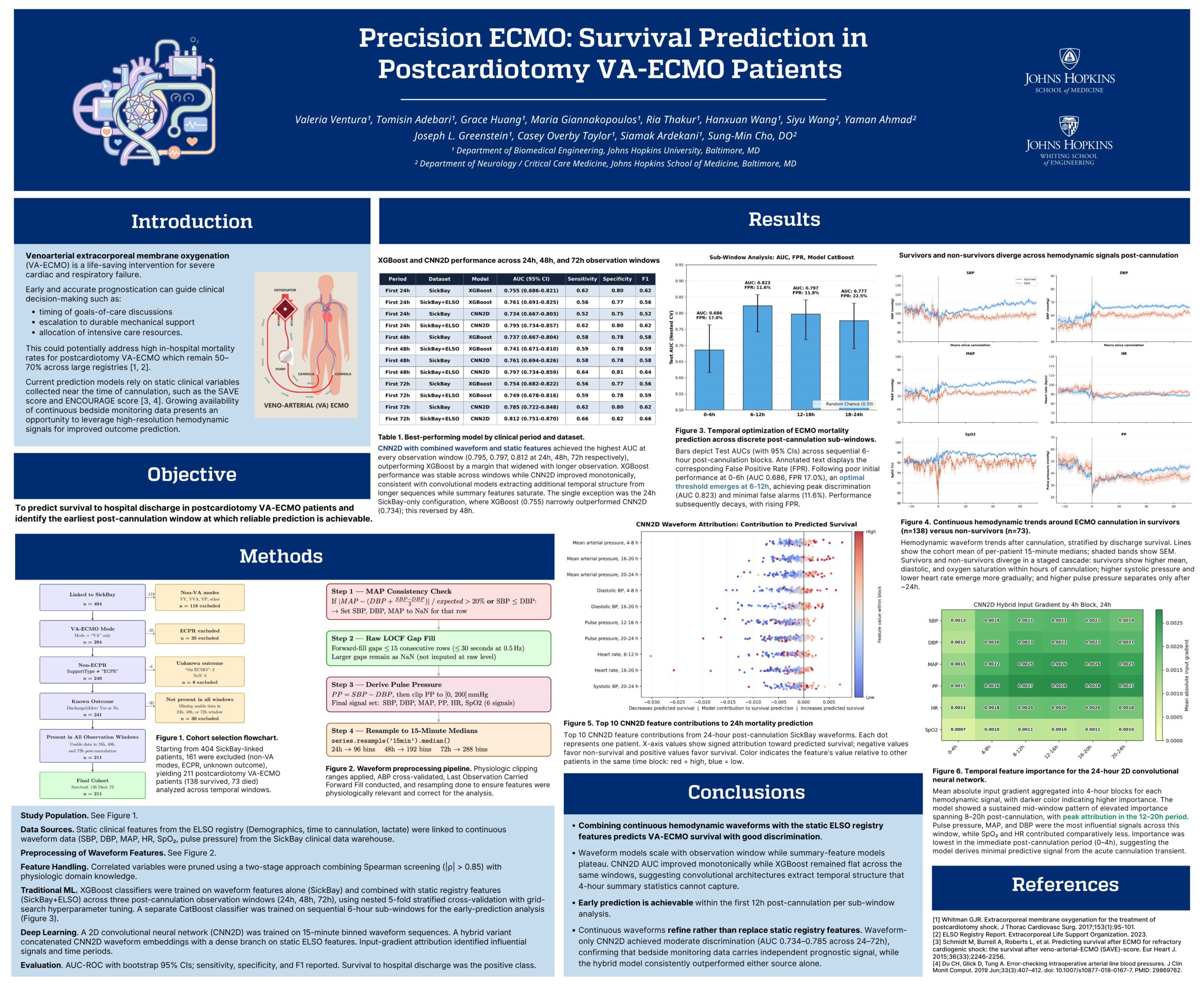
Postcardiotomy venoarterial extracorporeal membrane oxygenation (VA-ECMO) carries 50–70% in-hospital mortality, yet current prognostic scores rely only on static variables collected at cannulation. This project integrates continuous high-resolution hemodynamic waveforms (MAP, SBP, DBP, pulse pressure, HR, SpO₂) from the SickBay database with Extracorporeal Life Support Organization (ELSO) registry data, to predict survival to hospital discharge in 241 adult postcardiotomy VA-ECMO patients. Traditional machine learning models and deep learning models were evaluated across pre-cannulation, first-24-hour, and 75 hours post cannulation windows. Notably, models trained on arterial blood pressure waveform features alone achieved discrimination comparable to models using static registry variables, underscoring the prognostic richness of continuous monitoring. Gradient attribution localized model-relevant signal to the early hours post-cannulation, supporting a two-stage framework: initial risk stratification at cannulation, progressively refined by bedside hemodynamics.
Project Photo:

Meet Team Frogfish! We’re putting our hearts into our ECMO research project. Our dedicated team is working together to analyze critical patient data and help clinicians make informed decisions for the patients who need it most.
Project Poster
Open full size poster in new tab (PDF)
Project Poster Summary:
Postcardiotomy VA-ECMO carries 50–70% mortality, and current prognostic tools rely on static variables collected at cannulation. We asked whether continuous bedside hemodynamic waveforms can improve and accelerate survival prediction. In 211 postcardiotomy VA-ECMO patients, we trained traditional Machine Learning and deep learning models on SickBay waveforms (SBP, DBP, MAP, PP, HR, SpO₂) alone and combined with ELSO registry features, across 24h, 48h, and 72h post-cannulation windows.
The hybrid CNN2D model reached AUC 0.812 at 72h and improved monotonically with longer observation windows, while XGBoost plateaued, suggesting convolutional architectures extract temporal structure that summary statistics miss. A sub-window analysis identified 6–12h post-cannulation as the earliest reliable prediction window (AUC 0.823, FPR 11.6%). Feature attribution across models converged on MAP, pulse pressure, and DBP in the 8–20h window as the dominant hemodynamic predictors, supporting clinical interpretability of the waveform-based approach.