

Create
Design Project Gallery
Predicting Rupture Risk in Cerebral Arteriovenous Malformations
- Program: Biomedical Engineering
- Course: EN.580.480 Precision Care Medicine
- Year: 2026
Project Description:
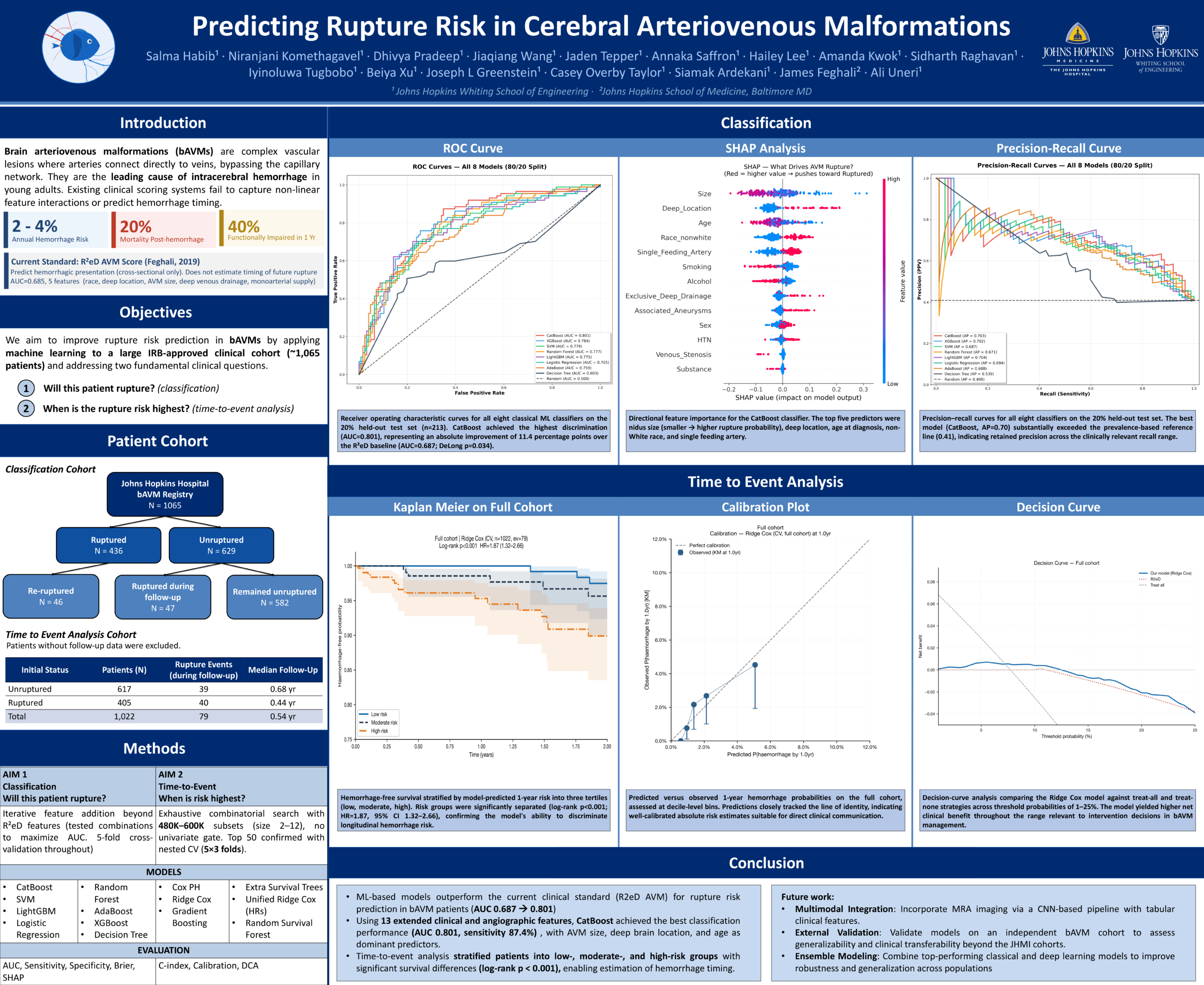
Brain arteriovenous malformations (bAVMs) are complex vascular lesions where arteries connect directly to veins, bypassing the capillary network. They are a leading cause of hemorrhagic stroke in young adults, yet current clinical scoring systems have limited predictive accuracy and cannot estimate when rupture may occur. We developed a machine learning framework using an IRB-approved cohort of 1,065 bAVM patients to improve risk stratification, addressing two clinical questions: whether a patient will rupture (classification) and when rupture risk is highest (time-to-event analysis). Among eight models evaluated, CatBoost achieved the best performance (Test AUC = 0.801), outperforming the standard R²eD score. Ridge Cox survival models further stratified patients into low-, moderate-, and high-risk groups with significant separation of hemorrhage-free survival (log-rank p < 0.001, HR = 1.83). This framework demonstrates the potential of machine learning to enhance clinical decision-making in bAVM management.
Project Photo:

Team Blue Tang’s mascot: a blue tang fish with cerebral arteries (red) and draining veins (blue) emerging from its body. Our project develops machine learning models to predict hemorrhage risk in brain arteriovenous malformations, supporting treatment decisions for patients facing this rare neurovascular disease.
Project Poster
Open full size poster in new tab (PDF)
Project Poster Summary:
Brain arteriovenous malformations (bAVMs) are the leading cause of intracerebral hemorrhage in young adults, yet existing clinical scoring systems fail to capture non-linear feature interactions or estimate hemorrhage timing. Using an IRB-approved cohort of ~1,065 patients from the Johns Hopkins Hospital bAVM Registry, we developed machine learning models addressing two clinical questions: will a patient rupture, and when is risk highest? For classification, CatBoost trained on 13 extended clinical and angiographic features achieved AUC 0.801 (sensitivity 87.4%), outperforming the R²eD AVM baseline (AUC 0.687; DeLong p=0.034). For time-to-event analysis, a Ridge Cox model stratified patients into low-, moderate-, and high-risk groups with significant survival differences (log-rank p<0.001) and well-calibrated 1-year hemorrhage probabilities. Future work includes multimodal MRA integration, external validation, and ensemble modeling to improve generalization across populations.