

Create
Design Project Gallery
Artificial-Intelligence Powered Digital Ocular Motor Biomarkers of Parkinson’s Disease
- Program: Biomedical Engineering
- Course: EN.580.480 Precision Care Medicine
- Year: 2026
Project Description:
This project develops an AI-driven framework for early Parkinson’s disease (PD) diagnosis using non-invasive ocular motor biomarkers. While eye movement abnormalities such as saccades, fixations, and smooth pursuit, often precede classical symptoms, a lack of labeled clinical data hinders current diagnostic abilities. To solve this, we generated physiologically guided synthetic data by modeling PD-specific dysfunctions within known mathematical frameworks. Using the ControlNeXt pose-guided pipeline, the raw waveforms are converted into realistic eye-movement videos. This approach addresses data scarcity and provides clinicians with a more objective diagnostic tool. Our framework is validated through expert review, statistical comparisons with real patient distributions, and multimodal classifier testing. By bridging mathematical modeling and video synthesis, this project offers a scalable, objective tool for early PD screening, providing a path toward more accessible neurological diagnostics.
Project Photo:

Team Beluga is developing an AI-driven framework to improve early Parkinson’s diagnosis through eye-tracking. By converting mathematical models into realistic synthetic videos, we address the shortage of clinical data and provide doctors with more objective diagnostic tools. Our team is dedicated to bridging this gap to make neurological screening more accessible.
Project Poster
Open full size poster in new tab (PDF)
Project Poster Summary:
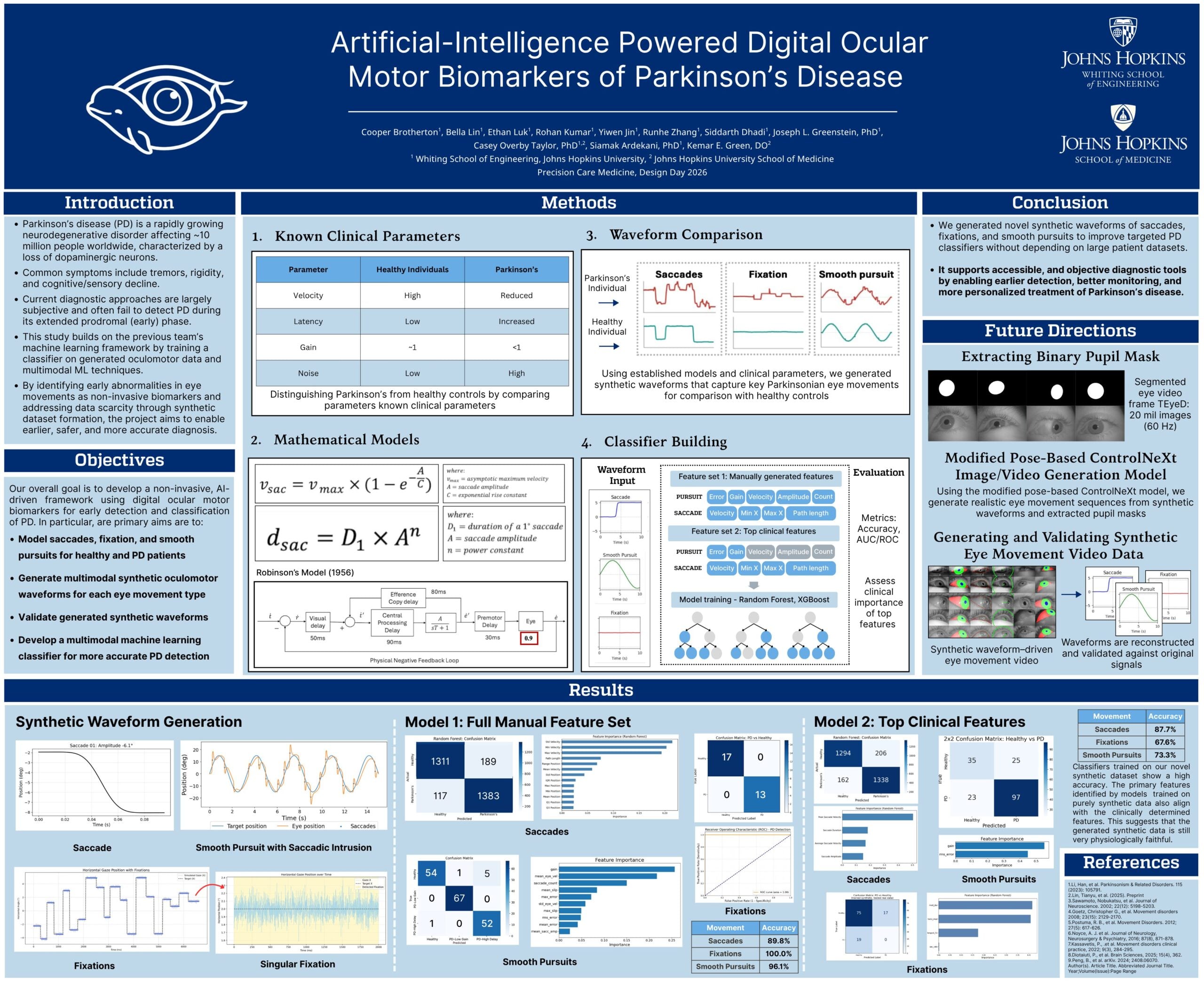
Our poster presents an AI-driven framework for detecting Parkinson’s disease using digital ocular motor biomarkers. By modeling eye movements, specifically saccades, fixations, and smooth pursuits, we were able to generate synthetic, multimodal waveform data that replicates clinical patterns observed in both patients with Parkinson’s disease and healthy individuals. Moreover, established mathematical models and clinical parameters were combined to simulate realistic eye movement patterns, enabling robust synthetic data generation without any large precursor patient datasets. Machine learning classifiers, primarily Random Forest models, were trained on both manual and clinically derived features, achieving high accuracy in distinguishing Parkinson’s and healthy cases. Overall, the poster shows our cumulative approach that highlights the potential of non-invasive, accessible diagnostic tools for earlier PD detection and monitoring. Finally, future work will focus on improving the model through video-based validation and pose-guided models, which support scalable and personalized detection of Parkinson’s disease.