

Create
Design Project Gallery
AutoAspira: Automating Breast Cancer Biopsies for Enhanced Diagnosis
- Program: Biomedical Engineering
- Course: EN.580.497 Advanced Design Team
- Year: 2025
Project Description:
Manual Fine Needle Aspiration (FNA) biopsy is often used to diagnose breast cancer in Sub-Saharan Africa (SSA). While performed with ultrasound guidance in the United States, most SSA healthcare centers lack imaging resources, rendering clinicians unable to consistently sample breast lesions with adequate cellularity, leading to high false-negative rates, repeat patient visits, increased financial burden, and delayed treatment initiation. Our solution, an automated handheld device, has shown promise in improving sample cellularity as compared to manual FNA.
Project Photo:
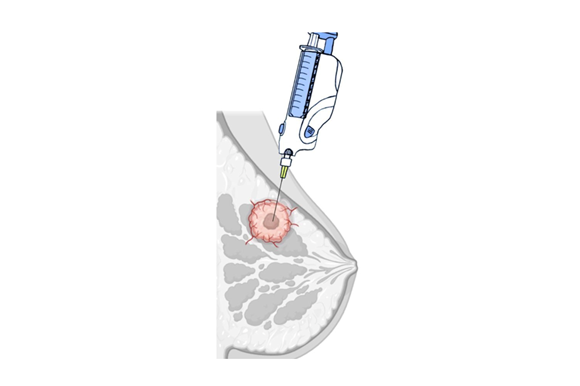
Cross-sectional view of AutoAspira’s handheld FNA device in use. Our team has developed a device that obtains representative diagnostic samples for accurate breast cancer diagnosis while also deskilling the FNA procedure to improve accessibility.
Project Poster
Open full size poster in new tab (PDF)
Project Poster Summary:
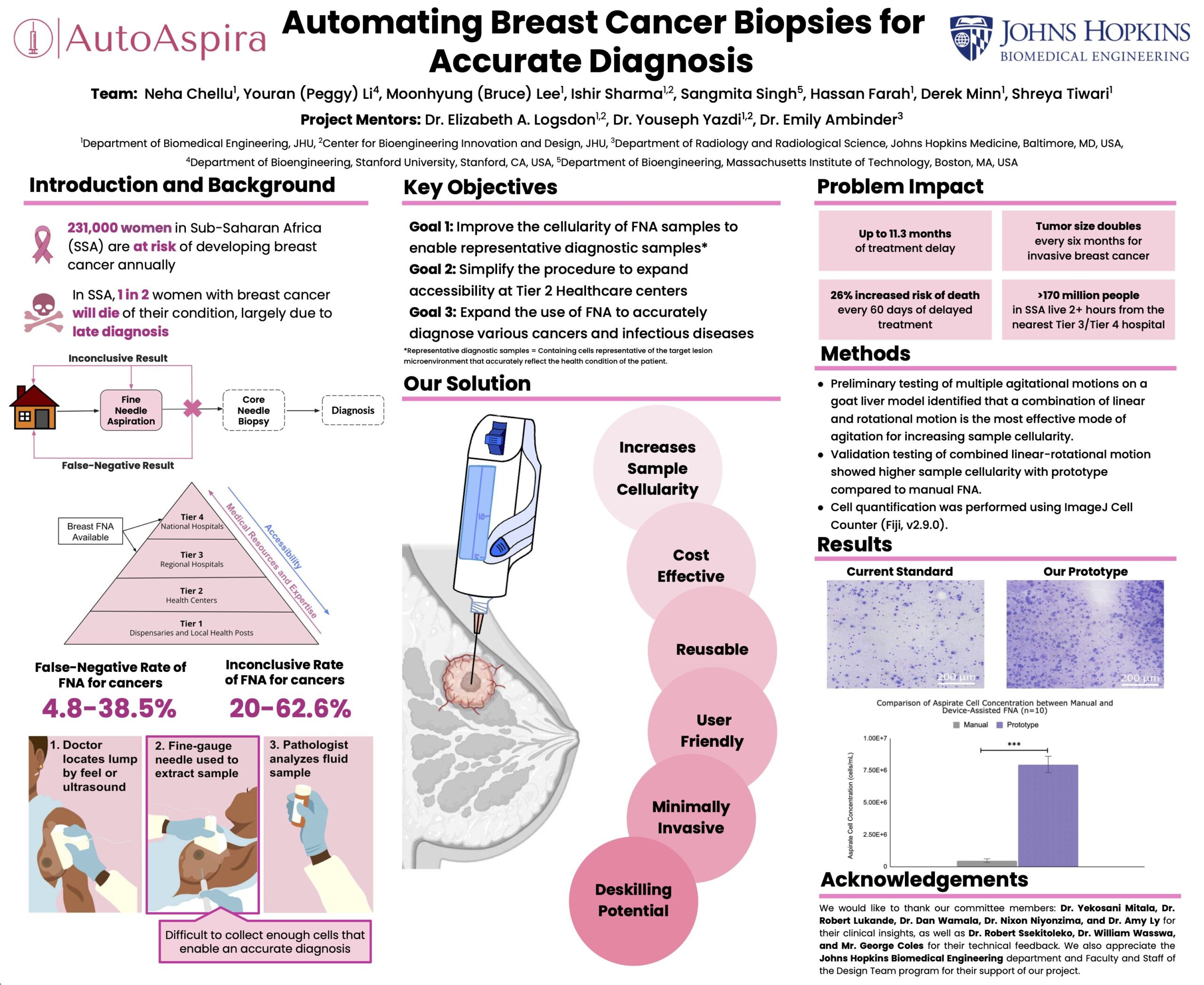
Manual Fine Needle Aspiration (FNA) biopsy is often used to diagnose breast cancer in Sub-Saharan Africa (SSA). While performed with ultrasound guidance in the United States, most SSA healthcare centers lack imaging resources, rendering clinicians unable to consistently sample breast lesions with adequate cellularity, leading to high false-negative rates, repeat patient visits, increased financial burden, and delayed treatment initiation. Our solution, an automated handheld device, has shown promise in improving sample cellularity as compared to manual FNA.
Project Video
Johns Hopkins biomedical engineering students are working to enhance breast cancer biopsies to improve cancer diagnosis in Uganda and other low- and middle-income countries.
Project Whitepaper
Manual Fine Needle Aspiration (FNA) biopsy is often used to diagnose breast cancer in Sub-Saharan Africa (SSA). While performed with ultrasound guidance in the United States, most SSA healthcare centers lack imaging resources, rendering clinicians unable to consistently sample breast lesions with adequate cellularity, leading to high false-negative rates, repeat patient visits, increased financial burden, and delayed treatment initiation. Our solution, an automated handheld device, has shown promise in improving sample cellularity as compared to manual FNA.