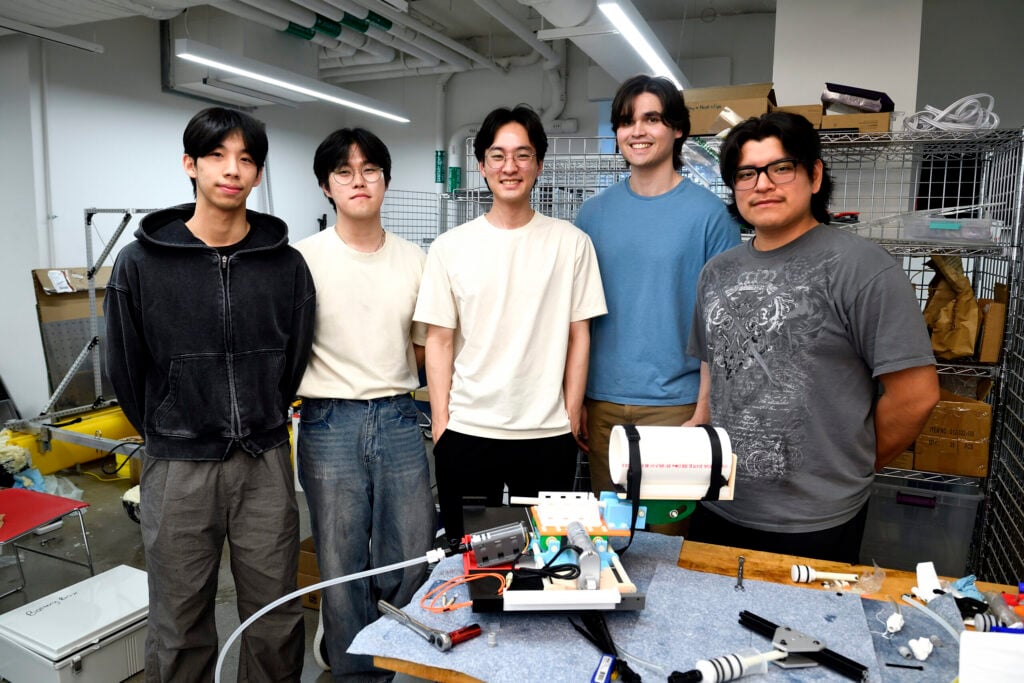
Team Members: Jacob Kim, Mason Holmes, Ariel Sanchez Perez, Han Zheng, Ethan Oh
Department: Mechanical Engineering
Motion during MRI scans poses a major challenge because even small movements can degrade image quality in ways that are difficult to detect and cannot be fully corrected afterward. This is especially problematic for patients who may struggle to remain still, such as those with ADHD, autism, or Parkinson’s disease.
A key difficulty in motion correction research is the inability to reproduce identical movements across repeated scans. This is necessary for evaluating prospective methods by comparing corrected and uncorrected images with the same motion. Furthermore, because MRI scans rely on a rapid sequence of radio frequency pulses, it is necessary to provide motion at exact times to study sequence-dependent effects.
To address this, a novel MRI-compatible motion platform capable of precisely simulating patient head movement during brain scans was developed. This system will support the development of improved motion correction techniques, provide insight on the effects of motion on MRI data, and help define thresholds for imaging sequences, guiding decisions on when scans need to be repeated.