
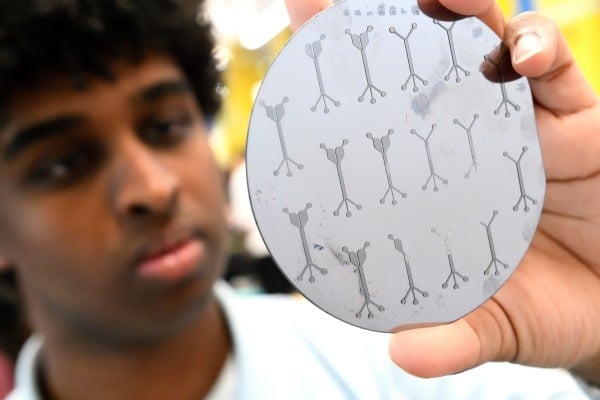
A team of biomedical engineering undergraduate students is developing a cell sorting device that could restore vision for canines suffering from corneal edema, a condition that can cause blindness. Their invention isolates the healthiest cells from a sample, preparing them for use in an emerging cellular injection therapy.
The students will present their project on April 28 at the Whiting School of Engineering’s Design Day—an annual event showcasing students’ innovation and ability to translate theoretical knowledge into real-world solutions.
Edema occurs when fluid over accumulates in the central layers of the cornea due to a dysfunctional endothelium layer, the innermost surface of the cornea. The eye becomes blue and “cobblestoned” in appearance from swelling of the tissue. Left untreated, this swelling ultimately leads to vision loss and blindness.
In humans, the condition can be treated with a corneal transplant that surgically replaces the damaged layer of the eye with donor tissue. But in dogs, surgical treatment remains a challenge due to a limited supply of donor tissue.
“Current treatment for canines mostly treats the pain and inflammation associated with corneal edema, but cannot restore vision,” said Hassan Farah, team leader and third-year biomedical engineering student.
Instead, cell injection therapy is a promising alternative that uses stem cells to restore vision. In the lab, the stem cells are differentiated into corneal endothelial cells and when injected into the eye, they settle on the back of the cornea and form a new functional monolayer.
However, the path from the lab to the clinic has one major hurdle: cell preparation. “While corneal cell injection therapy for treating corneal edema is a promising and growing approach in ophthalmology; its clinical adoption remains limited because there aren’t streamlined and affordable tools for preparing high-quality cell suspensions for injection,” said Farah.
To improve this process, the team has designed a device called Sort-A-Cell. Only a few inches in size, the device is more cost and space effective than current large cell sorters that need to be set up on lab benches. By removing dead cells and other artifacts that may compromise the culture, the device makes sure that only the healthiest cells are prepared for injection.
“Our approach leverages a compact, energy-efficient platform that uses acoustic waves to enable gentle, selective separation within a controlled microenvironment,” said Farah. “Because the cells don’t need chemical labels or extensive processing, they can be safely used in other clinical procedures without risk.”
Their device could be used broadly to streamline cell preparation for other injection procedures to treat conditions such as leukemia, myeloma, macular degeneration, heart disease, and more.
To better understand both the human and canine applications of their solution, the team worked closely with Allen Eghrari, director of the Dana Center for Preventive Ophthalmology at the Johns Hopkins Wilmer Eye Institute and Micki Armour, a veterinary ophthalmologist at Armour Veterinary Ophthalmology and Friendship Hospital for Animals.
Both mentors frequently interact with their counterparts working with humans or animals, which helped the team get a full perspective on how their solution could solve a need in both fields. The team was even able to shadow their veterinary mentor in the clinic to better understand the interaction between pet owners and clinicians in navigating care decisions and impact.
While the use of corneal endothelial cell injections is still in clinical trial phase, the team is charging into this “up-and-coming” arena. “There is limited data on the outcomes and workflows of this procedure, which has been both exciting and challenging for our team,” said Farah. “With the guidance of our mentors and looking at prior research on the use of stem cell injection therapy in other applications, our device has the potential to make an impact on the ease of providing clearer vision to canines and humans.”
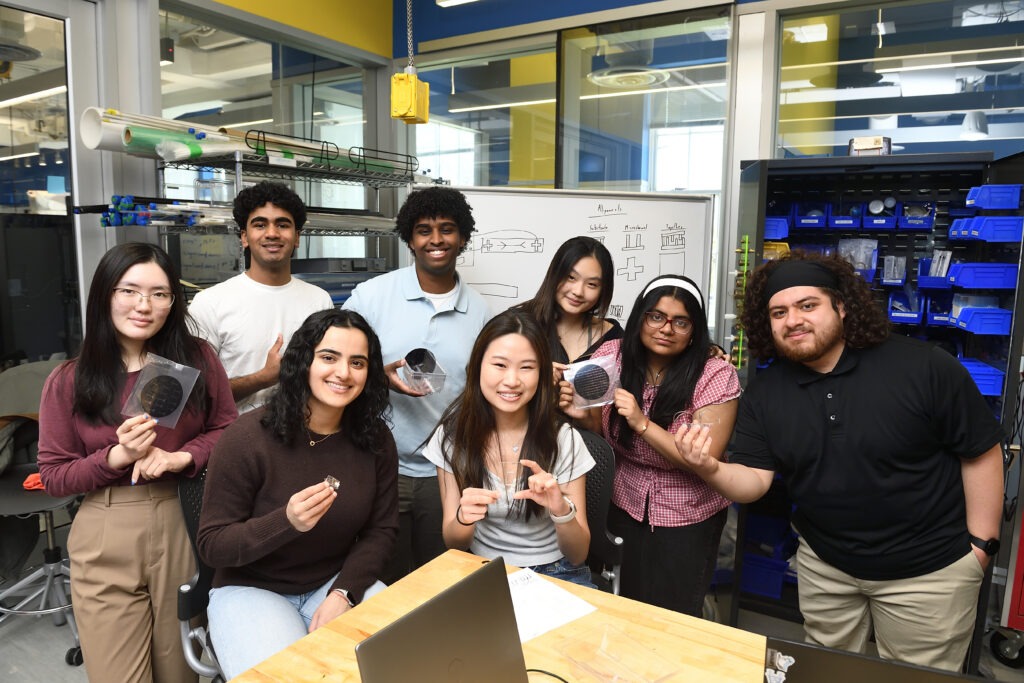
The design team also includes Aayushi Agarwal, Saketh Agava, Michelle Lu, Daniel Quinteros-Tenorio, Paree Sharma, Cindy Truong, and Ying Ying Li.