
Author: Dave Kiefaber
Photo by Will Kirk
Design Day is an annual showcase highlighting students’ creativity, innovation, and ability to turn classroom theory into practical solutions for real-world challenges. Presented each spring by the Johns Hopkins University Whiting School of Engineering, this year’s event takes place on April 28.
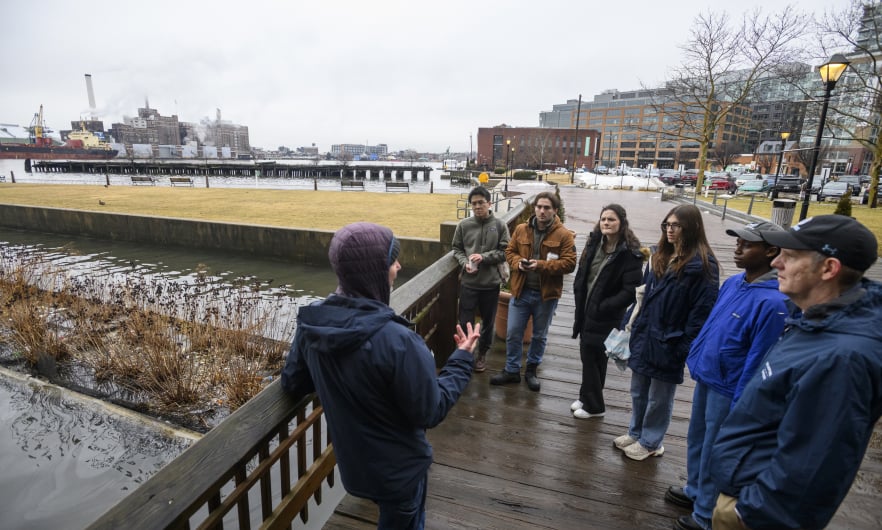
Two senior design teams from the Department of Environmental Health and Engineering are developing nature-based solutions to climate change impacts in one of Baltimore’s most culturally vibrant neighborhoods: Fells Point.
“This real-world challenge is being confronted by engineers and scientists everywhere as they struggle to find adaptable, resilient solutions that will protect our communities,” said Chris Overcash, co-lead instructor for the senior design course. “Providing our students with these project opportunities will give them the skills to help them excel in our changing world.”
One team’s focus is on flood protection at the street level. Fells Point is among the city’s most flood-prone areas during coastal storm surges or heavy rainfall. Ongoing projected increases in both annual rainfall and sea levels will make the impacts of these weather events more frequent and severe.
“Our goal is to create a feasible design that drastically reduces the intensity and frequency of flood events in Fells Point,” said team member Jasmine Munzel. Her team worked with a wide range of infrastructure engineers focused on green, resilient solutions and the City of Baltimore’s Department of Public Works to analyze existing stormwater management infrastructure and observe at-risk areas.
“We’ve been learning about the daily operations of the city’s stormwater management system, utilities layout in Fells Point, climate resiliency methods and design options, and realistic engineering process,” Munzel said.
After creating drainage maps using data from the Department of Public Works, the National Oceanic and Atmospheric Administration, and the city’s Disaster Preparedness and Planning Project, the flood team’s Thames Street pilot project focuses on a three-element design using increased storm drain capacity, living seawalls, and bioswales—roadside gardens that allow water to infiltrate into soil—to improve flood protection.
“There is no perfect solution,” Munzel said of her team’s diverse tactics. “Climate resiliency is all about finding the best possible solution, or combination of solutions, to mitigate climate threats.”
While Munzel and her team focused on ground-level improvements, the other design team’s bio-solar roof project took a more top-down approach to climate resiliency.

“We found that energy usage was a concern,” said team member Maya Savory. “With increased temperatures requiring more cooling in the summer, stronger storm events to break utility lines, and current outages already occurring, we wanted our project to focus on flood prevention and energy resiliency in the neighborhood. We ultimately found that a bio-solar roof was the best for both goals.”
Proposed for the Brown Advisory Building on Bond Street, a bio-solar roof—described by Savory as “a green roof with solar panels attached”—captures rainwater to reduce flooding at street level and produce clean energy to reduce the building’s energy demands. Like the flood prevention team, the roof team used NOAA data and valuable input from experts in the field, including BGE and Furbish, to inform their design.
“Finding a problem, analyzing possible solutions, then designing the solution are all important for engineers,” Savory said. “It was great to see how many projects and design opportunities there are in the sustainability and environmental engineering field.”
The flood resiliency team members are Lucas Rodriguez, Shannon Dixon, Victoria Black, Jasmine Munzel, and John Qian. The bio-solar roof team members are Maya Savory, Victoria Ines, Guilian Laudisa, Juny Lee, and Gianna Murphy. Their designs support a grant-funded initiative led by the University of Maryland’s Environmental Finance Center and its technical partner, Straughan Environmental, a Maryland-based engineering consulting firm.