
Author: Jonathan Deutschman
Photo by Will Kirk
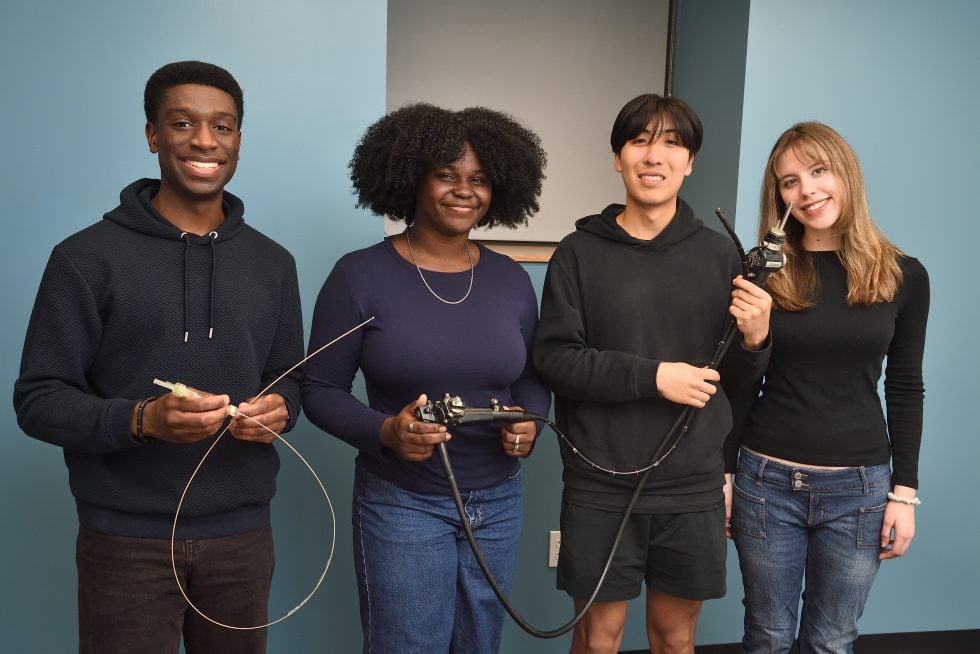
The first laparoscopic gastric bypass surgery, which physically shrinks the stomach, was performed in 1994, and over the past 30 years has revolutionized the clinical approach to managing obesity. This transformational procedure is not without its drawbacks, though, including the risks inherent to any invasive surgery and general anesthesia, as well as a long recovery period. A mechanical engineering senior design team has developed a less-invasive approach that achieves the same outcome as gastric bypass surgery but can be done in an outpatient setting with minimal preparation and recovery.
The team, sponsored by Dr. Venkata Akshintala at the Johns Hopkins School of Medicine, developed a way to inject a stomach-shrinking drug directly into the body via a 2.8 mm endoscope. Inserting the tube was the easy part; the hard part was getting the medication from the tube into the stomach. Their solution was to use 25 gauge needles, the typical size used in hypodermics.
“The whole environment is a lot smaller than all of us expected,” said team member Tunde Ayodeji. “We had to get used to working at this scale as none of us have ever done that before.”
Akshintala had already been using a similar system that employed just one needle. The team was tasked with expanding this process out to use multiple needles to save time and impact on the patient. The process the students developed starts with using a manifold to connect the fluid channel, which allows the drug to get from a syringe through the length of the endoscope to the needles: the fluid channel fits into one end of the manifold, and the needles are fixed into individual holes on the other end. The needles pass through the needle guide, a small piece with angled holes that allow the needles to spread, and that’s held in place with tubing as the needles are pushed through when the device actuates.
The students had to find a way to make the pre-bent needles fan out once they reach the stomach in order to inject the drug evenly. To do this, the team gave each needle its own guide at the bottom of the tube which is angled to allow the needle to flex and curve to reach the area it needs to go. Then they had to figure out how to make the process repeatable down to the micrometer.
“The handheld system at the top had to reliably trigger the components inside the patient to ensure the needles reached their destination every time,” said team member Kennedi Woods. “The small components required a lot of attention to detail as far as tolerance and adjusting.”
The team didn’t just design the device; they had to test it on an actual organ.
“We used pig stomachs to simulate the human stomach,” Ayodeji said. “That whole internal environment is smaller than we’re used to working in, so we had to wrap our heads around that. I think we did a good job figuring it out.”
The team, which includes members Cyrus Levy, Eva Loftus, and Aidan Chan Montano, will present their poster at the JHU Engineering Design Day event Tuesday, April 28, and the Department of Mechanical Engineering Design Day event on Thursday, April 30.