

Tiny life forms tucked into debris from an asteroid hit could catapult to other planets—including Earth—and survive, a new Johns Hopkins University study finds.
The work demonstrates that a certain hardy bacterium easily withstands extreme pressure comparable to an ejection from Mars after an asteroid hit, as well as the inhospitable conditions it would face during the ensuing interplanetary journey.
The study, published in PNAS Nexus, suggests that microorganisms can survive remarkably more extreme conditions than expected and raises questions about origins of life. The work also has significant implications for planetary protection and space missions.
“Life might actually survive being ejected from one planet and moving to another,” says senior author K.T. Ramesh, a mechanical engineer and the Alonzo G. Decker Jr. Professor of Science and Engineering, who studies how materials behave in extreme conditions. “This is a really big deal that changes the way you think about the question of how life begins and how life began on Earth.”
Impact craters cover the surfaces of most bodies in the solar system. Mars, a planet that could harbor life, is one of the most cratered celestial bodies. Scientists know asteroid strikes can launch material across space—and Martian meteorites have been found on Earth.
“We do not yet know if there is life on Mars, but if there is, it is likely to have similar abilities” — K.T. Ramesh
However, scientists have long wondered if life forms could be launched from an asteroid impact. Tucked inside ejected debris, they might land on another planet.
Previous experiments were inconclusive and focused on organisms common on Earth, not a life form that would suit the extreme environments of other planets.
To test a realistic planetary ejection, the team devised a way to replicate the pressure and a singular biological model: Deinococcus radiodurans. This desert bacterium from Chile is renowned for its ability to survive inhospitable, space-like conditions—from extreme cold and dryness to intense radiation—thanks to its thick shell and ability to self-repair.
“We do not yet know if there is life on Mars, but if there is, it is likely to have similar abilities,” Ramesh says.
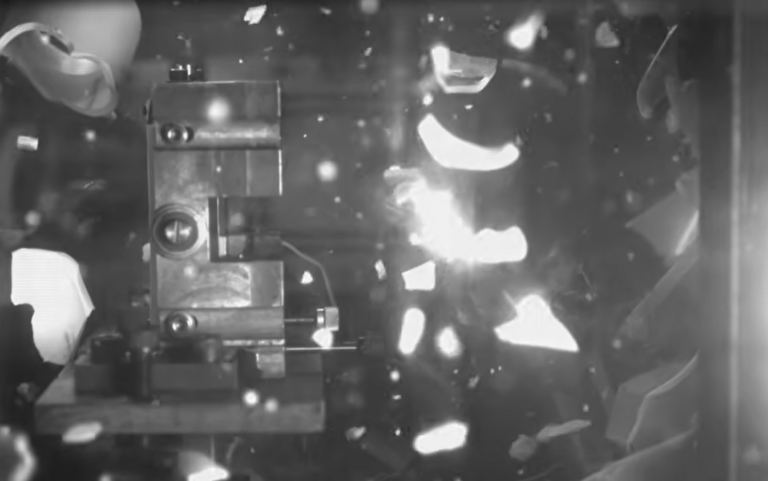
The experiment simulated the pressure of an asteroid strike and ejection by sandwiching the microbe between metal plates and then using a gas gun to fire a projectile at it at speeds up to 300 mph, generating 1 to 3 gigapascals, or GPas, of pressure.
For perspective, pressure at the bottom of the Mariana Trench, the deepest part of the Earth’s oceans, is a tenth of a GPa—so even the experiment’s lowest pressure was more than 10 times that.
Afterward, the team assessed bacteria survival and examined the survivors’ genetic material for clues to how they handled the pressure.
The bacteria were tough: Nearly all survived 1.4 GPa with no damage, and 60% survived 2.4 GPa, with some cells experiencing ruptured membranes and internal injury.
“We expected it to be dead at that first pressure,” says lead author Lily Zhao, Engr ’21 (MSE), a mechanical engineering graduate student. “We started shooting it faster and faster, but it was really hard to kill.”
In the end, what did die was the equipment. The steel configuration holding the plates fell apart before the bacteria did.
When asteroids hit Mars, ejected fragments can produce pressures close to 5 GPas or more. Here, the microbe easily survived almost 3 GPas, much higher than previously thought possible.
“We have shown that it is possible for life to survive large-scale impact and ejection,” Zhao says. “What that means is that life can potentially move between planets. Maybe we’re Martians!”
Current rules limit contamination of potentially habitable worlds and tightly control returned samples; if material can travel between planets naturally, those policies may need revisiting, the team says.
The team next hopes to explore whether repeat asteroid impacts result in hardier bacterial populations—or whether bacteria adapt to this kind of stress—and whether organisms like fungi can survive these conditions.
— JILL ROSEN