

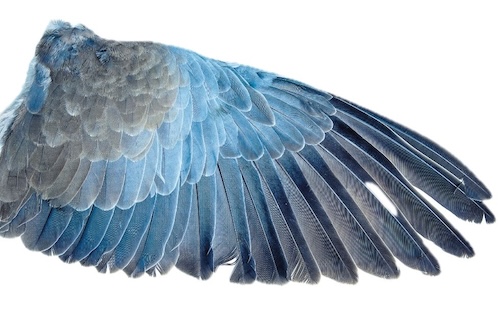

“In simulations, a three‑feather flapping wing produced up to twice the lift‑for‑energy efficiency of a single element—so you get roughly double the lift output for the same power. The linked feathers achieve this by letting air slip through them on the upstroke and capturing that air to improve lift on the downstroke. That reduces wasted forces and boosts performance, which could benefit small drones, flapping robots, and turbines.”
— Rajat Mittal, professor of mechanical engineering
Does your salad have a drug problem?

“As farms turn to reclaimed wastewater, we wanted to determine how lettuce, tomatoes, and carrots absorb and chemically alter four psychoactive drugs. It turns out leafy greens held the highest concentrations, while tomato fruit and carrot root had about 220-fold and sevenfold lower levels, respectively. Plants transformed the drugs into multiple metabolites, and the variety of these breakdown products tracked with how much original drug was present—not the plant species—raising questions about food safety implications.”
— Carsten Prasse, associate professor of environmental health and engineering
Can we reveal the secret lives of cells?

“Just like tree rings that document climate changes from centuries ago, GEMINI, a genetically encoded intracellular recording platform, creates ring-like molecular records of cellular histories inside cells. By looking at GEMINI’s cross sections under a microscope, we can read what individual cells have experienced via small, fluorescent ‘rings.’”
— Dingchang Lin, assistant professor of materials science and engineering and core researcher in the Institute for NanoBioTechnology