

As an undergraduate at the University of Texas, Austin, Nethra Venkatayogi enjoyed developing algorithms for medical technologies, but she felt she was missing out on the larger clinical picture.
Pursuing a doctorate under the guidance of Muyinatu “Bisi” Bell, the John C. Malone Associate Professor in the departments of Electrical and Computer Engineering, Biomedical Engineering, and Computer Science at Johns Hopkins, would rectify that.
“Hopkins was a very easy choice for me, because it’s tops for surgical research. Dr. Bell’s lab is especially the right place because she works on women’s health and medical imaging technologies that are very translatable to clinical research,” says Venkatayogi.
“In essence, we are making it more objective for clinicians, because otherwise radiology is dependent on the reader.” — Nethra Venkatayogi
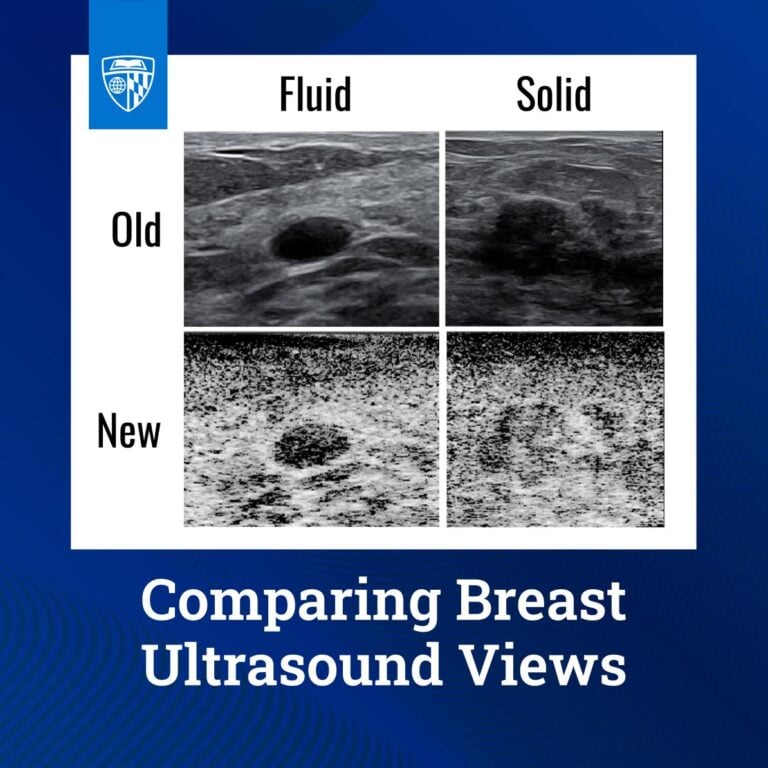
One of Venkatayogi’s early projects addresses the shortcomings of ultrasound in detecting breast cancer. When concerns arise in mammograms, women are usually advised to receive follow-up ultrasounds, but the imaging technology is imperfect in analyzing dense breast tissue, which can be found in nearly half of women aged 40-plus. Ultrasounds cannot easily distinguish (usually benign) fluid-filled cysts from solid potentially cancerous masses. As a result, women undergo anxiety-inducing biopsies even when they don’t need them.
The solution, developed in the PULSE Lab directed by Bell, interprets ultrasound images more reliably.
Venkatayogi developed a user interface that lets radiologists subjectively assess whether masses are solid or fluid-filled. This subjective assessment was compared with another algorithm developed in the PULSE Lab that uses a validated threshold to distinguish solid from fluid-filled masses. “In essence, we are making it more objective for clinicians, because otherwise radiology is dependent on the reader,” Venkatayogi says.
In initial tests with patients, doctors working with the new method accurately identified masses 96% of the time. They were right just 67% of the time analyzing the same masses with their regular tools. “Our achievement will change the landscape of how breast cancer is diagnosed,” predicts Bell. The results of the study appeared in Radiology Advances.
Now, Venkatayogi is working to improve surgical guidance for hysterectomies. During surgery, cutting off blood supply to the uterus is necessary to remove it. But sometimes surgeons accidentally cut or damage the nearby ureter, which transports urine from the kidney to the bladder.
To address this problem, Bell’s lab uses photoacoustic imaging to guide surgeons. The technique uses short laser pulses at different wavelengths to illuminate tissue, causing it to expand and create sound waves. These sound waves are then detected and processed to create images and image-based information. In the resulting photoacoustic image, the uterine artery appears different from the ureter, helping surgeons recognize and avoid errors.
Venkatayogi used her skills in breast radiology assessment to develop a user interface that allowed surgeons, residents, and engineers to evaluate the safety of the procedures based on various combinations of provided photoacoustic information. The results of the study were published in the International Journal of Computer Assisted Radiology and Surgery.
Venkatayogi is currently training an AI model with raw data obtained prior to the formation of a photoacoustic image. Trained on this data, the model will be able to identify and differentiate between the ureter, uterine artery, and a surgical tool tip. Based on initial user feedback, the system will deliver real-time surgical guidance, such as distance measurements and auditory warnings (similar to beeps from trucks reversing).
Bell appreciates these efforts toward making new technologies more easily adopted. “Nethra helps understand, for different technologies, what the users actually want, and what will be most beneficial to surgeons or those entering the field for the first time,” Bell says.
Venkatayogi’s efforts promise real impact. At a “Hopkins on the Hill” event in Washington, D.C., where she was showcasing her federally funded research, she met a woman who had undergone bladder complications after a hysterectomy. “She was so excited that there’s technology being developed to prevent this from happening to anyone else,” Venkatayogi says. “Explaining our research to the public really helps, because it reminds me why doing this work matters, especially when I hear from a patient who has gone through it.”
— POORNIMA APTE