
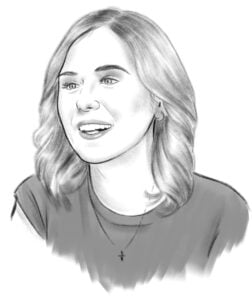
Rebecca Rosenberg has always been drawn to challenges. She excelled in STEM subjects from a young age, leading her to briefly consider a career in neurosurgery, “because it was the hardest thing I could think of,” she recalls. There was just one complication: Rosenberg was born with oculocutaneous albinism—a genetic condition that affects the eyes, skin, and hair, causing reduced pigment and vision differences.
“If a normal person sees in high definition, I see in standard definition,” she explains. “The world around me isn’t blurry; I just have fewer pixels.”
At school, Rosenberg’s vision level placed her in a gray area for support. Audio-only tools made it hard to focus, especially in classes like math, and when she asked to learn Braille, administrators denied her request, saying she was too sighted to justify the cost.
By her undergraduate years studying biomedical engineering at Bucknell University, Rosenberg had learned to advocate for herself. Professors enlarged and reformatted course materials—a simple fix that worked well for her and sparked a bigger idea: a scalable tool to help others maximize their usable vision.
With a summer grant, she began developing ReBokeh (a play on a photography term for light out of focus), an app that uses smartphone cameras to help people with low vision adjust contrast, zoom, and focus in real time, enhancing user independence in any environment.
Momentum built until the COVID-19 shutdown in March 2020. “Everything was upside down,” she says, “but a light at the end of the tunnel was getting into CBID at Johns Hopkins.”
The Center for Bioengineering Innovation and Design brings small teams together for an intensive one-year master’s program, during which they design and launch medical devices to solve real-world problems. An Abell Fellowship allowed Rosenberg to extend her work for a second year while applying what she learned directly to her startup.
“Everything was upside down, but a light at the end of the tunnel was getting into CBID at Johns Hopkins.”
— Rebecca Rosenberg
After graduating and completing a year of beta testing, she launched Re-Bokeh in June 2022. Early demand was strong, thanks to a waiting list built during development, but reaching new users proved difficult. She says a turning point came after an interview with BBC News. Within weeks, the app attracted users in 95 countries; it now serves people in more than 115 countries.
Since then, ReBokeh has expanded through partnerships with museums, transit systems, and sports leagues seeking to improve accessibility. The Clinton Presidential Library has become the first presidential library in the nation to offer ReBokeh.
Investments from startup accelerators and a Zero Project Award—presented at the United Nations in Vienna—have further validated Rosenberg’s mission.
“There are 25 million Americans with low vision, and even more who will have vision changes as they age,” Rosenberg notes. “It’s exciting to build something that can help at that scale.”
— ERIN LEWIS
Illustration by Joel Kimmel