

People
- Deepan Sharma
- Jian Gao (Former Postdoc)
Objectives
- All turbulent wall-bounded flows of practical interest involve dynamically relevant roughness.
- Some of these involve compliant surfaces and may feature two-way coupling with the boundary layer.
- Most existing modelling tools do not resolve the flow near the wall.
- There is a paucity of experimental data around the roughness despite their relevance to important phenomena – e.g. noise production (fluctuating wall pressure, WSS, and forces on roughness elements)
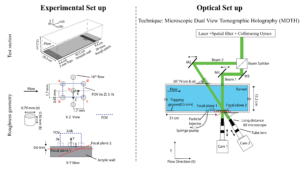
- Recent advances in measurement capability at JHU have made it possible to fully resolve velocity, pressure, and forces generated by individual roughness elements
Current work
Work done:
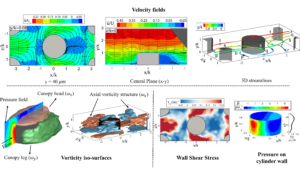
(i) 3D mean flow field (ii) vortical structures (iii) Reynolds, (iv) shear stress distribution, (v) pressure field focused around the element and (vi) mean hydrodynamic force on the cylinder (vii) contributions of viscous and form drag on total drag for friction based Reynolds number of 2120
Ongoing work:
Perform fully resolved (space + time) volumetric measurements of velocity/pressure/form drag within the roughness canopy of TBLs
- Obtain low-frequency (at least) time-resolved wall shear stress (WSS) measurements
- Calculate the unsteady pressure field, and hence unsteady forces on the roughness element by integrating the pressure distribution around it.
Facility
Results
Ongoing rough wall work (DARPA)
Previous results