Proto-Object Modeling
Team member(s)
- Uejima Takeshi
- Elena Mancinelli
Publications
- Proto-Object Based Saliency Model with Second-Order Texture Feature
- Computational stereo-vision model of proto-object based saliency in three-dimensional space
- Neuromorphic visual saliency implementation using stochastic computation
- Live demonstration: Real-time implementation of a proto-object-based
- How is motion integrated into a proto-object based visual saliency model?
- Proto-object based visual saliency model with a motion-sensitive channel
- A model of proto-object based saliency
Saliency is a tendency that humans tend to gaze at interesting points. Understanding and predicting saliency is an important topic in neuroscience and computer vision. Our goal is to implement a more accurate and bioplausible model of saliency on computers.
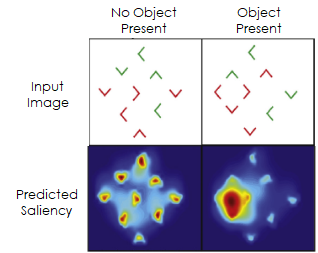
Our model which is called as a proto-object based saliency model, is bottom-up fashion and mimics visual cortex V1 and V2 behaviors. The significant property of the model is that it can indicate high saliency at “grouped features” based on Gestalt principles (Fig.1). This is achieved by the model of border-ownership cells which have been found in monkey visual cortex V2 and hypothetical grouping cells which integrate the global contour information of figures into tentative proto-objects (Fig.2).
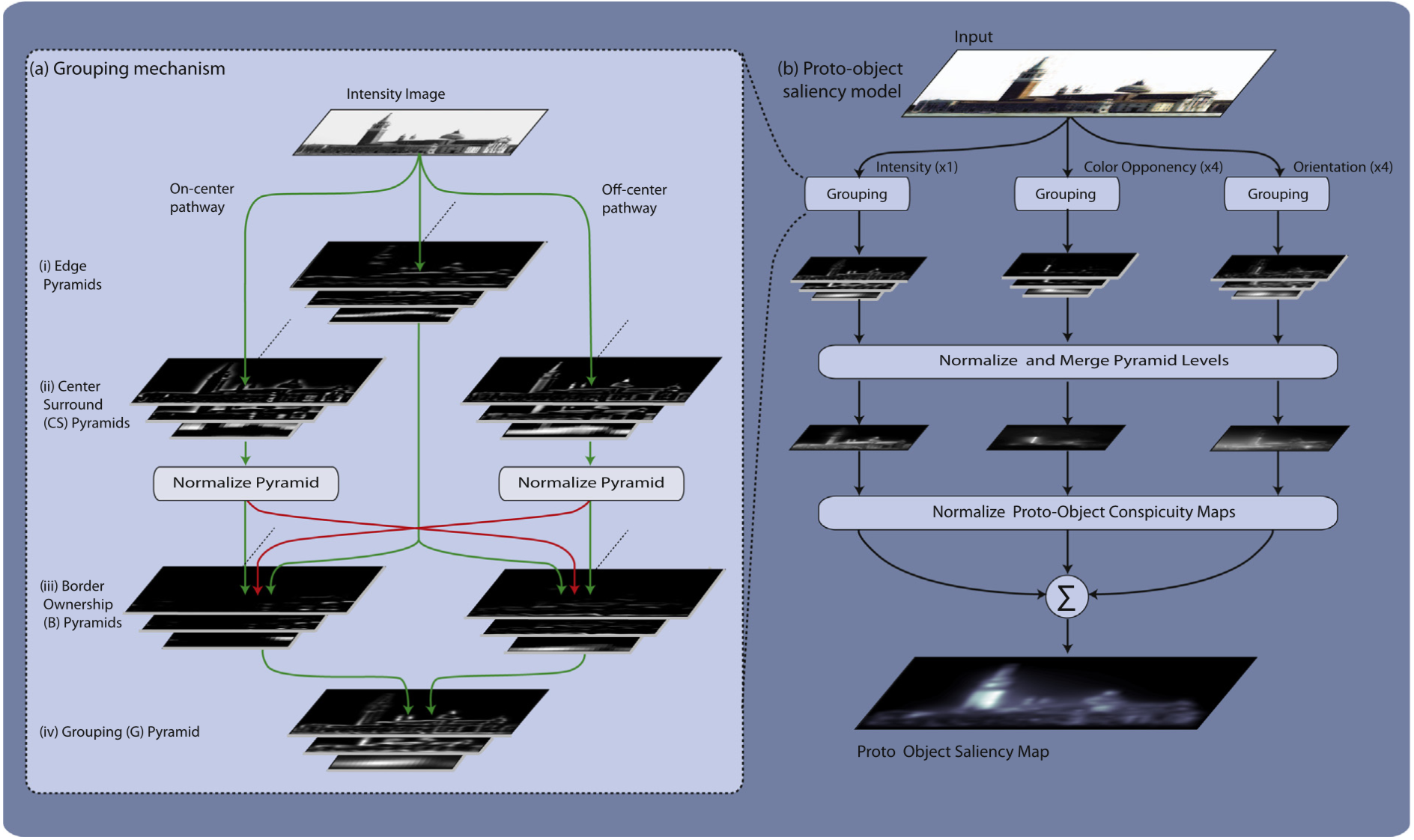
Though the basic model employs simple features such as intensity, color, and orientation, it can be extended by adding other features used by biological visual process. Recent advances in the lab have added motion, depth information, and simple texture to the model.